MiniMax-H3-Image in 2 Steps With a pDMD LoRA
A pDMD 2-step LoRA takes MiniMax-H3-Image from 6 steps to 2 at native 16 MP: 25.1 s down to 17.4 s an image, with ready ComfyUI workflows.
 | 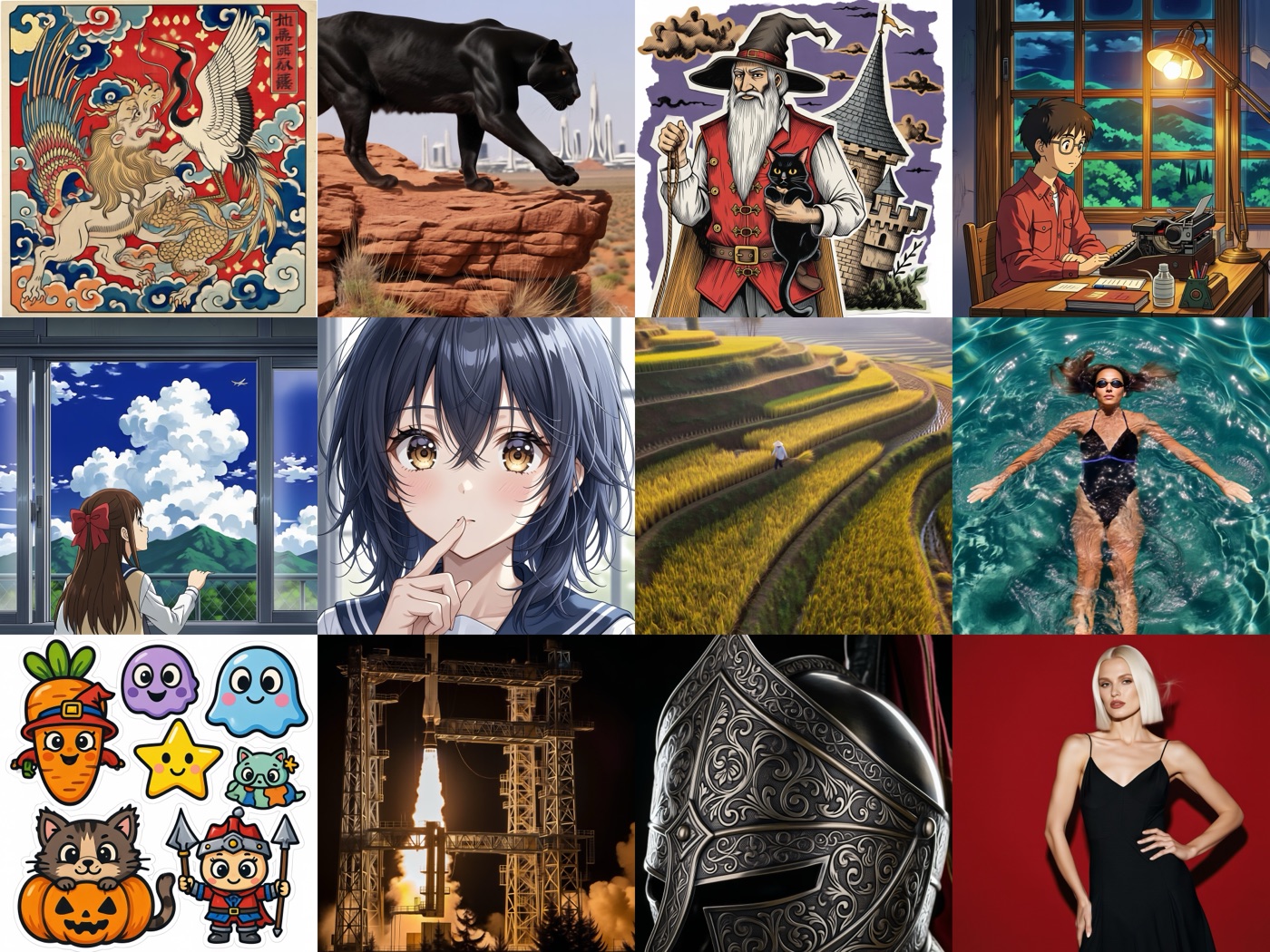 |
|---|---|
| Stock checkpoint, 2 steps | With the pDMD LoRA, 2 steps |
Twelve prompts, 4096x4096, two steps, flow shift 12, seed 3. The stock model cannot go below its fixed 6-step schedule, so at 2 steps it is still mid-denoise.
Run it
Two ways to load it, same graph.
- One file: download the 40 GB
minimax_h3_image_pdmd_2step_bf16.safetensorsintoComfyUI/models/diffusion_models/, plus a Qwen3-VL-32B text encoder and the image VAE from Comfy-Org/MiniMax-H3-Image. The LoRA is already merged, so no LoRA node and no strength to set. - Base plus LoRA: keep your current Comfy-Org checkpoint and add the 2 GB
minimax_h3_pdmd_2nfe_comfyui.safetensorstoComfyUI/models/loras/, with LoraLoaderModelOnly at strength 1.0 between Load Diffusion Model and MiniMaxH3SigmaShift. This is the only route for theint8_convrotandw4a8repacks, since pre-merged weights cannot be built on rotated or quantized tensors.
Then sample 2 steps, euler, scheduler simple, denoise 1.0, shift_video 12, no CFG. The latent comes from EmptyHunyuanLatentVideo because the H3 image latent is a single frame.
What the speed buys you
| Setup | 4096x4096, one H200 |
|---|---|
| Stock, 6 steps | ~25.1 s |
| pDMD LoRA, 2 steps | ~17.4 s |
| 2 steps plus IC refine pass | ~50 s |
Per image the gain is about 1.4x, not 3x: 2 steps instead of 6, but each step at 16 MP carries the same 33B transformer. The bigger win is iteration speed on the demo Space, which renders 2048x2048 in about 4.6 s with its detail pass, against about 7 s for the official 6-step Space at the same size.
Two steps holds for most prompts. Graphic prompts can invent pseudo-text and composition can drift from the stock result; 3 steps is the safe middle, and 4 steps is the closest to the 6-step output. Same for edits.
Detail pass
Draft at half size in 2 steps, upscale in pixels with lanczos, VAE encode, then a second sample at 3 steps with denoise = sigma_0. The start sigma is the knob: 0.4 to 0.55 polishes while holding the draft, 0.7 adds more detail but can speckle flat areas and drift faces. For edits, stay at or below 0.55.
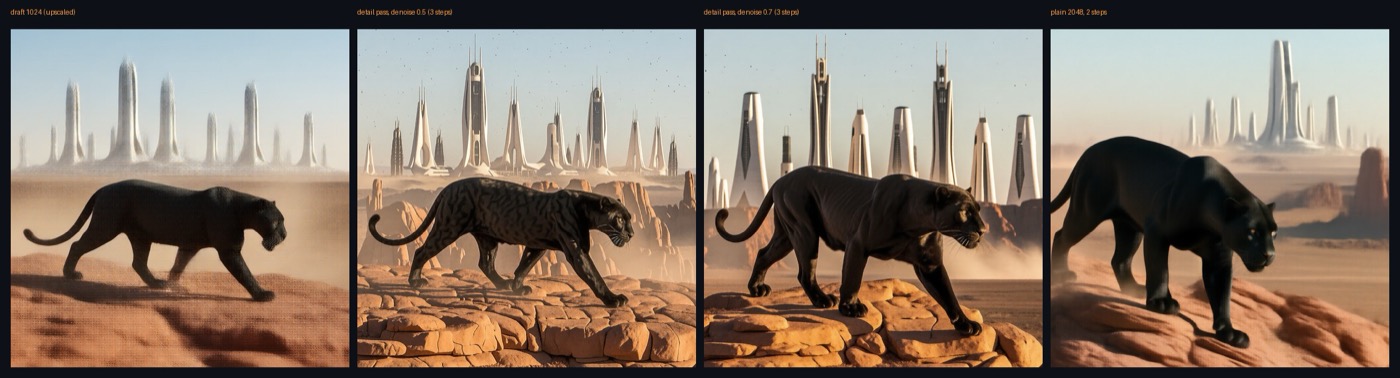
Half-size draft (left), the pass at 0.5 and 0.7 (middle), plain full-size 2-step render (right). The pass adds 1 to 2 s at 4 MP.
Realtime previews
Because a 2-step frame is cheap, the demo Space renders about 1 MP while you type, roughly 0.9 s per frame on its FP8 build, and polishes when you pause. That is what the LoRA unlocks: the stock schedule is stuck at 6 steps.
Live prompt editing on a Mona Lisa source, one 2-step frame per chunk.
Availability
- LoRA, workflows and grids: akhaliq/minimax-h3-image-pdmd-2step
- Demo Space: akhaliq/minimax-h3-image-2step
- Base model: MiniMaxAI/MiniMax-H3-Image, ComfyUI repack in Comfy-Org/MiniMax-H3-Image
- LoRA upstream: pdmd2026/pdmd_2NFE_lora, method in arXiv 2609.35768
Comments
Sign in with GitHub to join the discussion.