SnapRef v2a Weights Each Reference Photo for Anima in ComfyUI
SnapRef v2a stable adds a weight per reference photo and two mode presets for Anima, plus six ComfyUI workflows and a 195 MB FP8 option.

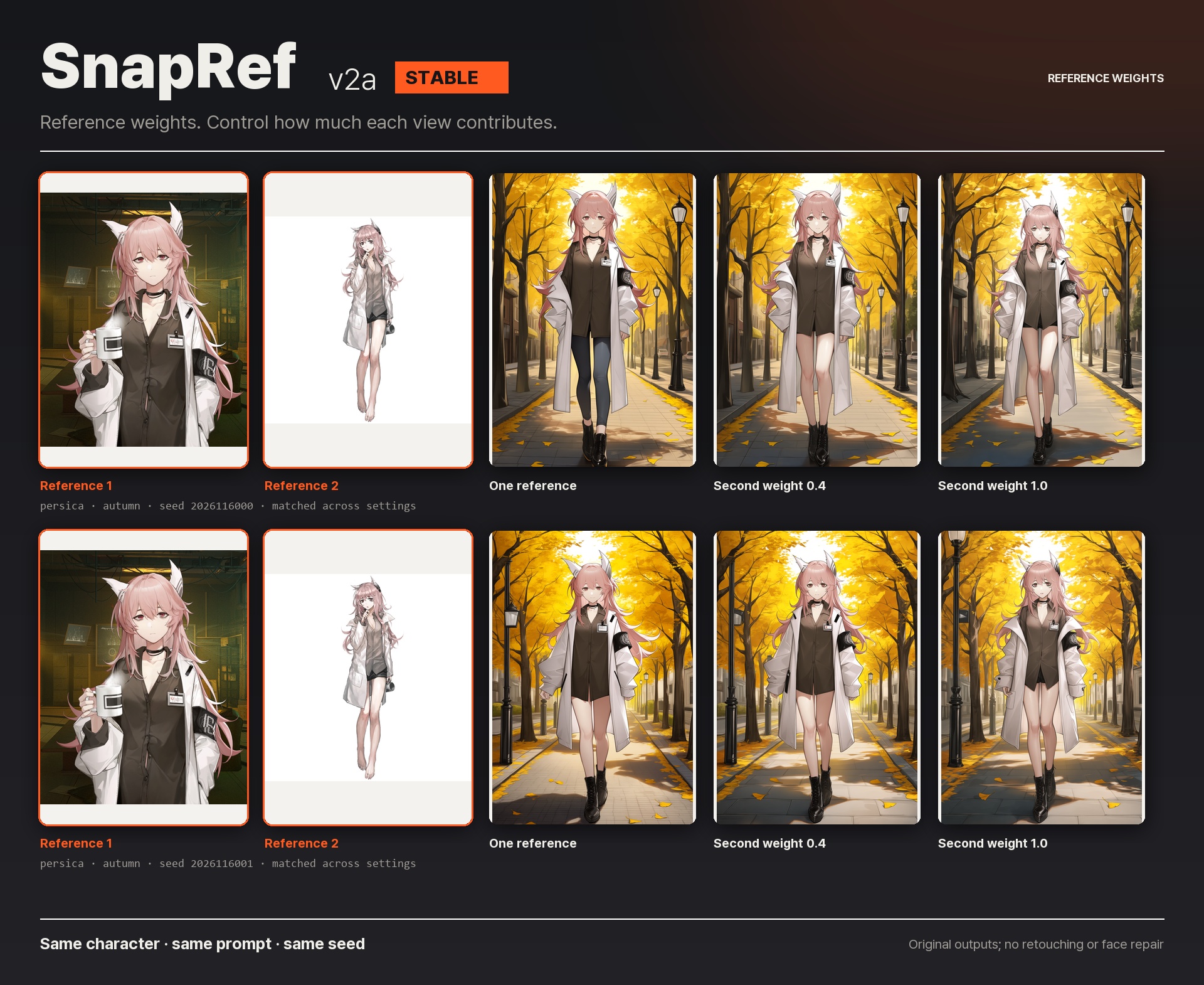
Four references, three scene prompts. Orange outlines mark the inputs; the prompts name no character and no appearance tags.
What changed from v1a
- A weight per reference. In the
separatelayout each photo gets its own weight, 1.0 by default and 0 to switch it off. A second photo set to 0.4 nudges the look instead of taking it over. - Two modes in the simple node. Character & Style carries over the reference's rendering, Character takes only the character so artist tags and style words decide the look.
- Six workflows, including two characters, and a reference-weight comparison that ships with its own prompts and seeds.
 |
|---|
| Two fixed seeds per row: one reference, second reference at 0.4, then at 1.0. On the same pair, 1.0 is not always the better result. |
Run it
- Install Anima base v1.0 with its text encoder and VAE.
- Copy
comfyui/snapref/from the repository intoComfyUI/custom_nodes/snapref/and restart ComfyUI. - Put
snapref_v2a.safetensorsinComfyUI/models/loras/. Use the SnapRef node, not LoraLoader: the file is two LoRA branches behind one key and a plain LoRA loader will not read it correctly. - Open the workflow below, drop a photo on the picture slot inside the node, and write only the scene.
The simple graph runs 28 steps, Euler with simple, CFG 4.5 and fidelity 1.0 at 832 x 1216. For two views of one character, the second workflow sets the second weight to 0.4:
An FP8 file is 195 MB instead of 382 MB. It stores E4M3FN matrices with per-row scales and the node restores them to bf16 at load, so images can differ slightly from the full weights.
What to expect
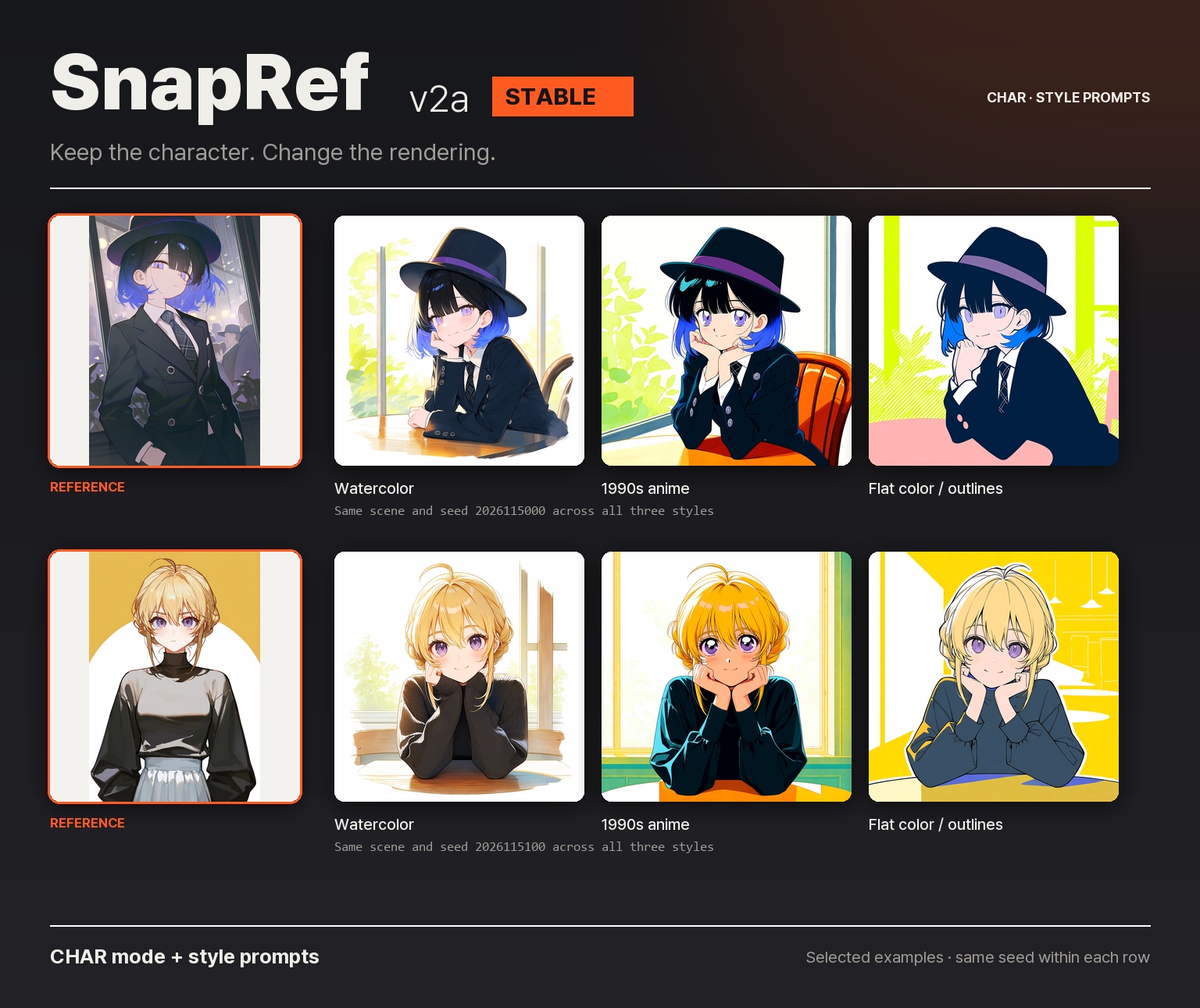
char mode, matched seeds per row: the reference supplies the character, the prompt supplies the style.

A second view adds outfit and silhouette. Weight 1.0 for Persica, 0.4 for Mia, chosen examples rather than an average score.
On the authors' fixed evaluation (64 cases, two seeds), v2a is level with v1a rather than ahead of it: appearance-tag recall 0.8722 to 0.8727, head SigLIP 0.8989 to 0.8903, full-image CCIP distance 0.0725 to 0.0757. Their qualitative read is better reference following, and the card still flags bright reference faces as a weak spot for facial detail. Metrics move with framing, pose and head detection, so treat them as a sanity check.
If v1a already gives you the character you want, there is no reason to switch for accuracy alone. The reasons to move are the per-reference weights and the v2a-tuned workflows.
Availability
- Weights, nodes, six workflows and figures: 0ppxnhximxr/snapref-v2a
- Training, data and evaluation code: ArcAnima/SnapRef
- Earlier release: snapref-v1a, covered in SnapRef v1a
Comments
Sign in with GitHub to join the discussion.