ComfyUI adds a Video Deflicker node for per-frame upscales
ComfyUI core now has Kijai's Video Deflicker node: it removes flicker from per-frame processed video, with a native RAFT flow 2.3x faster than torchvision.
ComfyUI core gained a Video Deflicker node: give it frames that flicker after per-frame processing, such as a frame-by-frame upscale, and it pulls each frame toward its neighbours while keeping its own detail. It landed through PR #17754 by Kijai, merged on 15 November. The only extra file you need is torchvision's RAFT-large checkpoint in ComfyUI/models/optical_flow/.
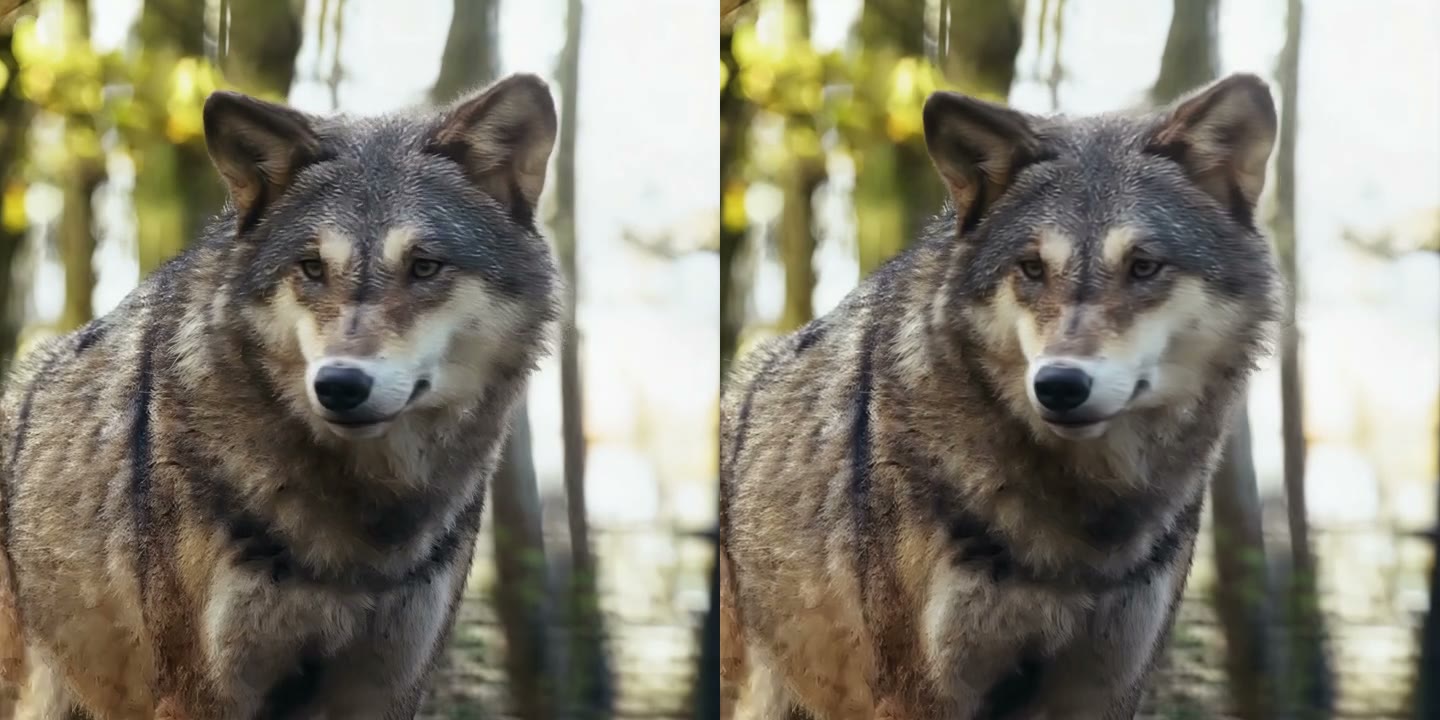
Left: a clip processed frame by frame. Right: the same clip after Video Deflicker. Source: Comfy-Org/ComfyUI #17754
Both clips side by side, 53 frames each, re-encoded at 720 px per panel.
What it fixes
- Per-frame upscales and per-frame edits, where every frame is processed on its own and the small differences between them read as flicker.
- Passing the clean source as
guideis what makes it work well: the node reads motion from those stable frames instead of from the flickering ones. Without a guide it uses the input frames and removes less. - Real changes survive.
thresholdmarks differences against the motion-compensated neighbour as genuine, so a cut or a fast gesture is not smeared away.
How to run it
- Download
raft_large.pth(torchvision RAFT-large, 21 MB) from download.pytorch.org intoComfyUI/models/optical_flow/. ComfyUI never downloads optical-flow weights by itself. - Add Load Optical Flow Model, pick
raft_large.pth. - Add Video Deflicker (category
video) and connect the flow model, the flickering frames, and the clean source frames toguide.
| Input | Default | What it does |
|---|---|---|
optical_flow | required | RAFT-large from Load Optical Flow Model |
images | required | the flickering frames |
guide | images | stable frames to read motion from, any resolution |
strength | 1.0 | how hard each frame follows its neighbours; higher smooths more fine detail |
direction | bidirectional | averages a forward and a backward pass; forward takes half the time |
threshold | 0.1 | changes above this stay sharp; 0 smooths every change alike |
Flow is computed at most at 768x768 internally, so a 4K guide is downscaled for the motion estimate and only the solve runs at full resolution.
Faster RAFT in core
The same PR replaced torchvision's raft_large with a native implementation: fp16 networks with fp32 correlation, and the update loop runs as a CUDA graph under dynamic VRAM. It is about 2.3x faster than the torchvision version at 1024x576. The VOID warped-noise nodes now use it as well.
Availability
The node is in the main branch as of the 15 November merge. The latest tagged release, v0.45.0 (10 November), predates it, so use a nightly build until the next release.
Comments
Sign in with GitHub to join the discussion.