Idol Turbo Cuts Image-to-3D to Five Guidance-Free Steps
Idol Turbo distils Speridlabs Idol from 50 guided steps to five guidance-free ones, 100 network evaluations down to 5, with two phase LoRAs that drop into the ComfyUI Idol repack.
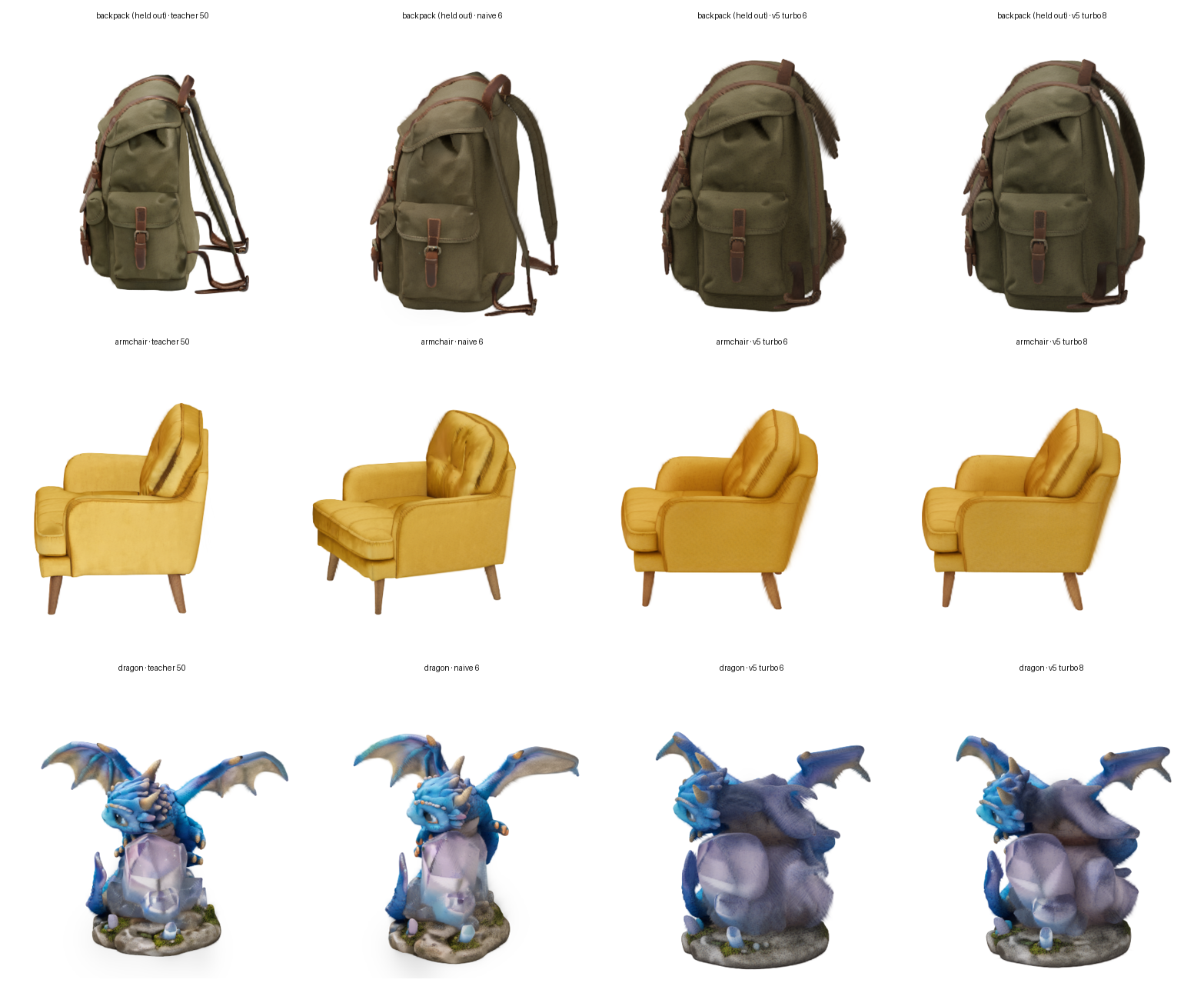
Input, the base model at 6 steps with CFG, and the distilled student at 6 and 8 steps. Same inputs, same seed, orthographic splat renders.
What changed
Idol's flow-matching denoiser is untouched. What the author added is two low-rank experts trained by regression against the teacher's CFG-composed velocity, so classifier-free guidance is folded into the weights and the second, duplicate pass disappears. That is where most of the saving comes from: 50 steps times two evaluations at CFG 3.0 is 100 network calls, and the student needs 5.
- Recipe: Glance-style phase LoRA (arXiv 2512.02899), two rank-32 experts, a Slow-LoRA for the high-noise phase and a Fast-LoRA for the low-noise phase, switching at t = 0.5.
- Trainable size: 29.4 million parameters across both experts.
- Training set (v5): 4,650 teacher records, 50-step CFG 3.0 trajectories over 93 single-object images, 2,000 steps, about 25 minutes on one H200.
The v5 label matters. Earlier checkpoints trained on 10 images and generalised poorly to objects unlike that set; the wider spread is the point of this release, and the backpack in the showcase is held out of training.
Five objects, three panels each: input, turbo at 5 steps, base model at 5 steps with CFG.
Using it in ComfyUI
The two ComfyUI-format LoRAs are verified against Comfy-Org/Idol: the module paths are identical and the weights are pre-scaled for strength 1.0. Drop idol_turbo_slow_comfy.safetensors and idol_turbo_fast_comfy.safetensors into models/loras/ next to the repack's diffusion model, DINOv3 CLIP vision, VAE and decoder, then set 5 steps and CFG 1.0.
There are two ways to wire the phase split:
- Two-stage: run the first four of five steps with the slow LoRA in
KSampler (Advanced)withadd_noiseon, then finish the last step with the fast LoRA andadd_noiseoff. The handoff sits at shifted t = 0.5. - Simple: use the slow LoRA for the whole run. At five steps, four of them are in its phase anyway, at the cost of some late detail.
The author's caveat is worth keeping: key compatibility is verified, but the two-stage split has not been run inside ComfyUI itself. If the fast stage looks off, the slow-only path is the safe default.
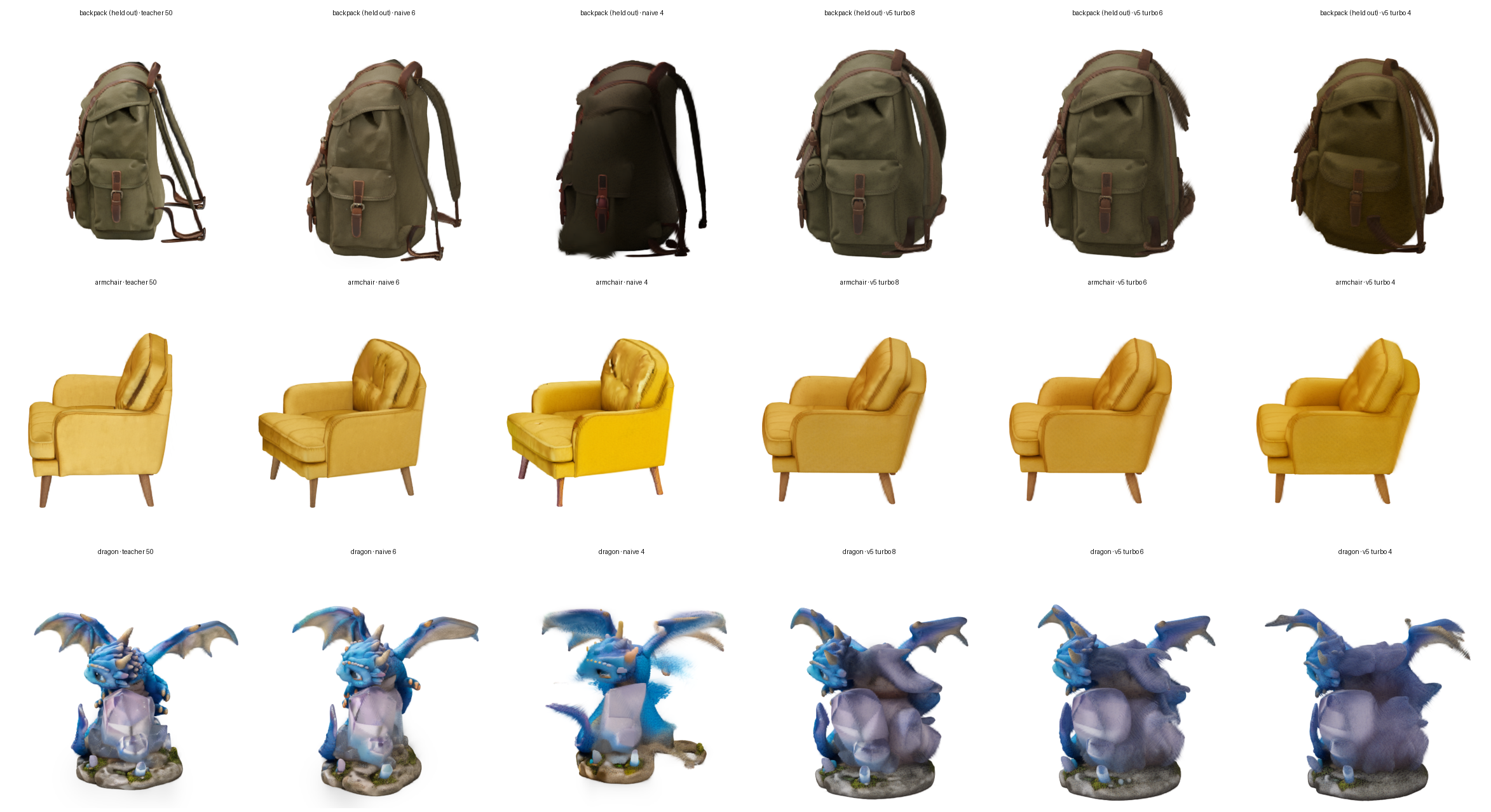
Down the step counts: the naive sampler loses colour (the backpack goes near-black at 4 steps) and structure (the dragon melts), while the student holds both without guidance.
The recommended default is 5 steps, where the gap between naive and turbo sampling is widest. At 8 both look good; below 4 both degrade, the student more slowly.
Where it is weaker
The model card is explicit. Outputs can come out softer than the 50-step teacher, colours can run warm at 4 steps, and highly saturated objects can land slightly less vivid than the first 10-image checkpoint. The base model at 50 steps remains the reference, and every training run, metric and evaluation render is published in akhaliq/idol-turbo-runs.
For the SDK path the repository is a drop-in weight replacement: denoiser, decoder, Gaussian decoder, background remover and config are byte-identical to speridlabs/idol, and turbo.py adds the guidance-free sampler.
Availability
The ComfyUI LoRAs, the SDK LoRAs, turbo.py and the comparison grids are on Hugging Face, published on November 3, 2026. It needs the Comfy-Org Idol repack to run, and the SDK path still wants Idol's two gated encoders (DINOv3 and FLUX.2-dev). The base Idol needs roughly 7.2 GB of VRAM; the LoRAs add a fraction of a gigabyte on top.
Comments
Sign in with GitHub to join the discussion.