Pika H3 Flex Turbo: 2, 4 and 8-Step H3 LoRAs in One File
akhaliq fuses Pika H3 Flex with H3 few-step distills into seven single-file LoRAs: 2-step drafts, 4-step speed, 8-step HD and a rank-32 lite build.
Pika shipped Flex as two LoRA adapters on top of the H3 base, and the few-step world already had turbo distills for the same base. Stack both and you get what the author wanted: Pika's post-trained motion at half the evaluations. Stacking two LoRAs in a ComfyUI graph works, but it needs two loaders, two strength widgets and a folder of files where one would do, so every file here is a single fused adapter.
No custom nodes and no model patches. Drop one file into ComfyUI/models/loras, load it with LoraLoaderModelOnly at strength 1.0 on your existing H3 workflow, and pick the step count the file was built for.
 |  |
|---|---|
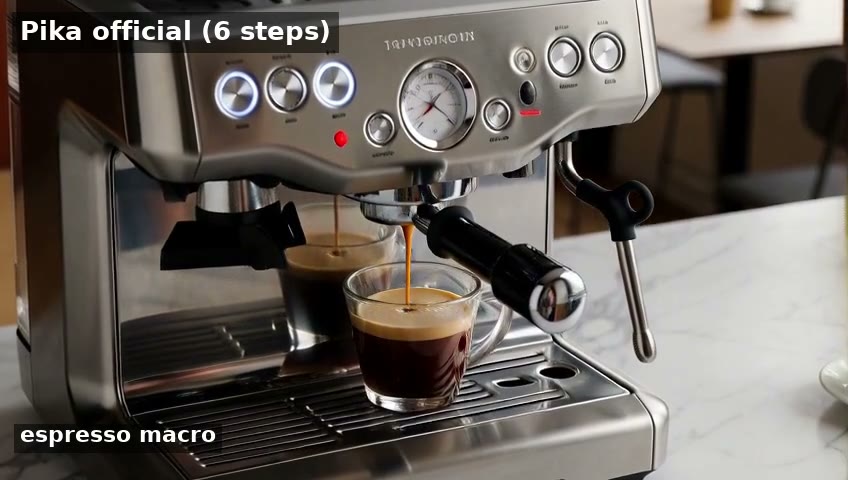
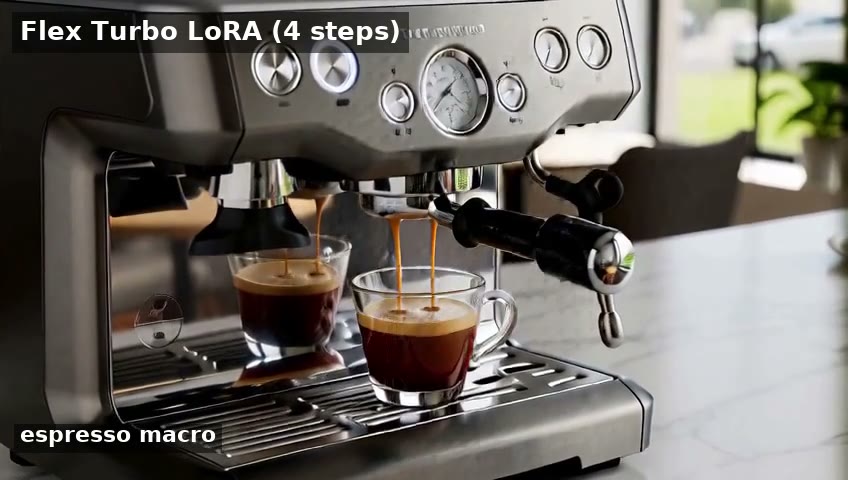
| Pika official adapter, six steps | Four-step turbo LoRA, same seed |
One prompt from the project's head-to-head clip on stock int8 H3, split into its two panels: official six-step on the left, the four-step LoRA on the right.
Five prompts, same seed, 848x480 with stereo audio: official six-step (left) against the four-step LoRA (right).
One file per speed
The lineup splits by transformer and step count, because H3's two video transformers do different jobs. Reference-to-video files are for reference workflows and quality merges, FL2VA files for the stock text and image paths.
| File | Transformer | Steps | Size |
|---|---|---|---|
pika_h3_flex_turbo_2step_draft_ref2va.safetensors | Ref2VA | 2 | 3.9 GB |
pika_h3_flex_turbo_4step_fl2va.safetensors | FL2VA | 4 | 3.9 GB |
pika_h3_flex_turbo_4step_ref2va.safetensors | Ref2VA | 4 | 3.9 GB |
pika_h3_flex_turbo_8step_hd_fl2va.safetensors | FL2VA | 8 | 3.9 GB |
pika_h3_flex_turbo_8step_hd_ref2va.safetensors | Ref2VA | 8 | 3.9 GB |
pika_h3_flex_turbo_4step_fl2va_lite_r32.safetensors | FL2VA | 4 | 0.31 GB |
pika_h3_flex_turbo_4step_ref2va_lite_r32.safetensors | Ref2VA | 4 | ~0.3 GB |
The 4-step half is lightx2v v1.2 768p for FL2VA and ref2v v0.1 for Ref2VA, chosen explicitly over v1.3, which the author calls an acknowledged stacking regression. The 2-step file fuses pDMD 2-NFE instead. Flex style is baked in at 0.5 for the 2 and 4-step files and 0.6 for the 8-step HD pair, the strength range the H3 community settled on for stacking a style adapter over a few-step distill.
The two lite_r32 files are a rank-32 compressed build: exact QR-product truncation that keeps 96.1% of the fused spectral energy at 0.31 GB, 12.6x smaller than the full 3.9 GB adapter.
Exact fusion, not an approximate merge
Naive additive merging of two LoRAs collides in the output-side B matrix, which the author cites from a 2026 paper on LoRA composition. Concatenation cannot collide, so each file is a per-layer rank concatenation:
B_fused @ A_fused == s·(B_flex @ A_flex) + 1.0·(B_turbo @ A_turbo)That makes the fused file functionally identical to loading both adapters stacked, by construction rather than by fitting. The author verified it numerically per layer before upload, with a worst relative error of about 2.6e-7 through a bf16 round-trip, then re-verified end to end on GPU with the clips below.
Measured speed
Same base, same seed, same prompt, CFG 1, 848x480 at 121 frames with stereo audio:
| Hardware | Configuration | Steps | Per 5-second clip | vs official |
|---|---|---|---|---|
| H200 | Pika official adapter | 6 | 60 s | 1x |
| H200 | This LoRA | 4 | 40 s | 1.5x faster |
| H200 | This LoRA, draft | 2 | ~25 s (14 s sampling) | ~2.4x faster |
| H200 | This LoRA, HD | 8 | 70 s | 0.86x, quality-max |
| A100 | Pika official adapter | 6 | 109.3 s | 1x |
| A100 | This LoRA | 4 | 66.0 s | 1.66x faster |
| Base H3 | no adapter | ~40 | ~500 s | ~8 to 12x slower |
Per-step cost is identical on the same card, about 7 s/step on H200 and 12.5 s/step on A100, so the entire saving comes from needing fewer evaluations rather than from a cheaper step.
Where it breaks
- The 2-step file is a draft tool. In the author's first test batch, 4 of 5 promotions held up. Use it to iterate framing and motion, then render finals at 4 or 8 steps.
- Audio degrades below six steps, which is true of every H3 turbo. It is worst at 2 steps, so render at 4 or more if the soundtrack matters.
- Step counts are not interchangeable. The 4-step files are tuned to exactly 4 steps and the 8-step HD pair rewards 6 to 8.
- Do not stack more strong adapters on top. Adding heavy style or motion LoRAs at high strength on the 2 and 4-step files undoes the point of the fusion.
The author also runs these on quality merges such as Singularity, where the 4-step Ref2VA file is the recommended pair, and reports that the combination is both faster and better looking than official Pika at six steps in the clip below.
The high-action stress test: martial arts and a skateboard run, official six-step (left) against the four-step LoRA (right). Few-step models are weakest on fast motion, so this is the clip to judge.
In ComfyUI
- Copy the file matching your transformer into
ComfyUI/models/loras. Ref2VA files for reference workflows and quality merges, FL2VA for stock text and image to video. - Load your usual MiniMax H3 workflow and add
LoraLoaderModelOnlyat strength 1.0. - Sample at 2, 4 or 8 steps to match the file, CFG 1.0, with
euler,lcmorres_multistepand thesimplescheduler. Flow shift 6.0 for FL2VA and 12.0 for Ref2VA, audio shift 3.0.
The repository also ships scripts/ with the five-way render and sampler sweep scripts used to produce the comparisons, plus sampler_sweep_results.json if you want to reproduce a specific panel. The files load through any H3-compatible loader, so Diffusers works too, and the same adapters run on int8 and GGUF H3 builds.
Availability
- akhaliq/Pika-H3-Flex-Turbo-LoRA on Hugging Face, with the seven adapters, six comparison clips and the render scripts
- Built on Pika H3 Flex, lightx2v/Minimax-h3-Turbo and pDMD 2-NFE over the MiniMax H3 base
- Frames in this article are taken from the project's own comparison clips
Comments
Sign in with GitHub to join the discussion.