Fibo 2.0: Bria's 8B open-weights model edits and generates images
Bria released Fibo 2.0, an 8B open-weights model that unifies image generation and editing in one set of weights, plus a 4-step Edit Turbo checkpoint.
Fibo 2.0 is Bria's next open-weights release in the FIBO family: an 8B-parameter flow-matching model that generates and edits images with one set of weights. Bria uploaded two checkpoints to Hugging Face on October 18 and 19 (Fibo 2.0 Dev | Fibo 2.0 Edit Turbo), and the model card cites an Artificial Analysis snapshot dated October 20 that ranks it first among open-weights models on the image-editing arena with an Elo of 1087, and second on the text-to-image arena.

The edited result returned for the multi-reference request below. Sample by Bria, published with its fal endpoint.
Two checkpoints, one architecture
| Fibo 2.0 Dev | Fibo 2.0 Edit Turbo | |
|---|---|---|
| Sampling | 50 steps, CFG 5.0 | 4 steps, guidance 1.0 |
| Tasks | generation and editing | editing only |
| Intended use | fine-tuning and research | low-latency edits |
| Repo size | transformer 16.25 GB + text encoder 8.88 GB + VAE 0.34 GB | same footprint |
Dev is the full, non-distilled base that Bria positions as the starting point for LoRAs and full fine-tunes. Edit Turbo is distilled from it for few-step, guidance-free editing, and Bria notes in the card that negative prompts have no effect there.
What is new in 2.0
The FIBO line was built around long structured captions: up to 1,000+ words describing lighting, composition, color, camera and depth of field as separate fields. Fibo 2.0 keeps that and adds a general editing path. Per the model card:
- Instruction edits that generalize across edit types while preserving identity, layout, lighting and fine detail in the regions you did not ask to change.
- Masked edits: the mask marks the area to regenerate, the rest of the image keeps its original pixels.
- Multi-reference edits with up to 4 images in total, referred to in the instruction as
<image_1>,<image_2>and so on. Bria lists virtual try-on, product integration and appearance transfer as the target cases. - Better text, texture and anatomy than earlier FIBO releases, with the same claim of state-of-the-art prompt adherence among open models.
The three inputs below are the reference images Bria ships with its published multi-image request (still-logo, still-perfume, still-background); the image at the top of this article is what the endpoint returned for it.
 |  |  |
|---|---|---|
still-logo reference | still-perfume reference | still-background reference |

A text-to-image sample from Fibo 2.0, from the generation request Bria publishes with the model. Sample by Bria.
Inside the model
Fibo 2.0 is a single-stream DiT with 44 blocks, running flow matching in the latent space of the FLUX.2 VAE. Prompts are encoded by Qwen3-VL-4B-Instruct; for edits, the context images go through both the VLM and the VAE. A two-layer Perceiver resampler compresses the VLM output into 256 to 512 "gist" tokens, more for longer prompts, and those tokens are prepended to the image tokens. Five of the DiT blocks also take cross-attention from internal VLM layers.
The practical consequence is that the model reads a JSON document rather than a sentence. Fibo 2.0 is trained on VGL (Visual GenAI Language), and Bria's open bria-vgl package turns a plain instruction into that document with modify(), or a prompt into one with create(). The pipeline returns the JSON alongside the image, so the same request can be replayed and diffed. bria-vgl itself runs on Gemini, so the expansion step needs a GEMINI_API_KEY; hand-written VGL documents skip it.
Availability
The weights are gated on Hugging Face: both repos require accepting Bria's terms before the files download. On the inference side:
- diffusers:
BriaFibo2Pipelineis not merged yet (PR #14991), so the card's install line points at a branch build. - Hosted: Bria's platform and API,
bria/fibo-2/generateandbria/fibo-2/editon fal, and two public Spaces,briaai/Fibo-2.0-T2Iandbriaai/Fibo-2.0-editing, the latter running Edit Turbo. - ComfyUI: there is no loader for Fibo 2.0 yet. Core ComfyUI ships Bria nodes that call Bria's API for the earlier FIBO models, Bria's own node repo (ComfyUI-BRIA-API) has not been updated for this release, and no Comfy-Org repackage or community single-file build exists, so the local text encoder and transformer cannot be dropped into
models/the way a FLUX or Qwen-Image checkpoint can.
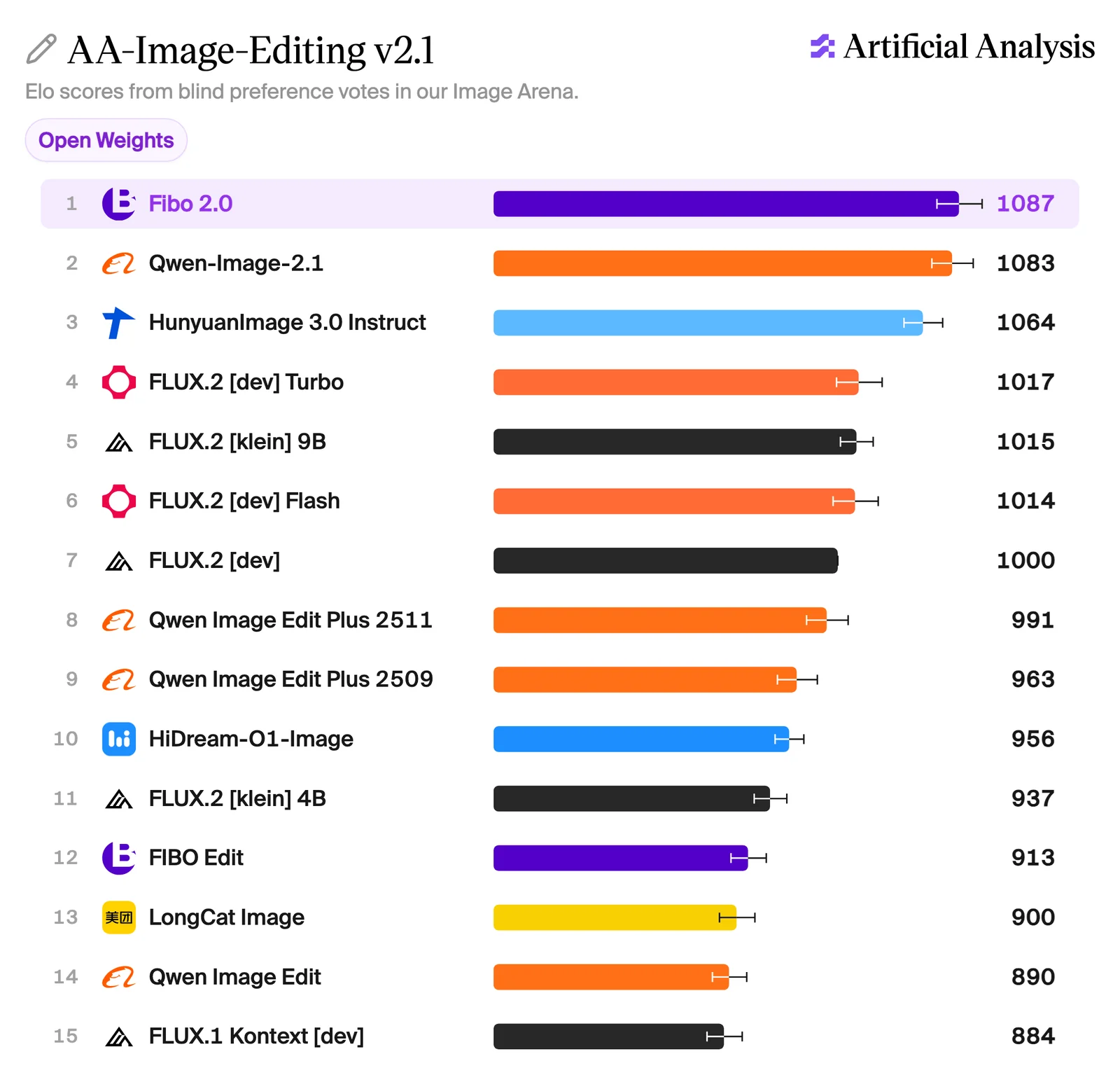
The open-weights image-editing leaderboard Bria cites in the model card, snapshot dated October 20, 2026.
Announced, not shipped
The card also lists five follow-ups that are not part of this release: a multi-turn local editing LoRA that chains edits while keeping the rest of the image pixel-stable, native background removal, a product shot LoRA, a "boring reality" style LoRA, eraser by mask and image expansion. Treat them as roadmap items until the weights appear.
Comments
Sign in with GitHub to join the discussion.