FastH3 Omni: 8-step H3 reference video with synced audio
FastVideo released FastH3 Omni, an 8-step MiniMax H3 distillation that turns image, video and audio references into one clip with stereo sound, plus ComfyUI weights.
FastH3 Omni is FastVideo's reference-conditioned variant of MiniMax H3: a prompt plus ordered image, video and audio references become one clip with synchronized sound, produced in eight transformer evaluations instead of base H3's 50. The Hao AI Lab team published the weights and the release write-up on October 20, with ComfyUI-ready single-file conversions in the same collection.
The model takes up to nine images, three video clips and three audio clips, twelve references in total, and needs at least one image or video. Output is video with 32 kHz stereo audio at 24 FPS in 124, 243 or 362 frame lengths, which is 5, 10 or 15 seconds.

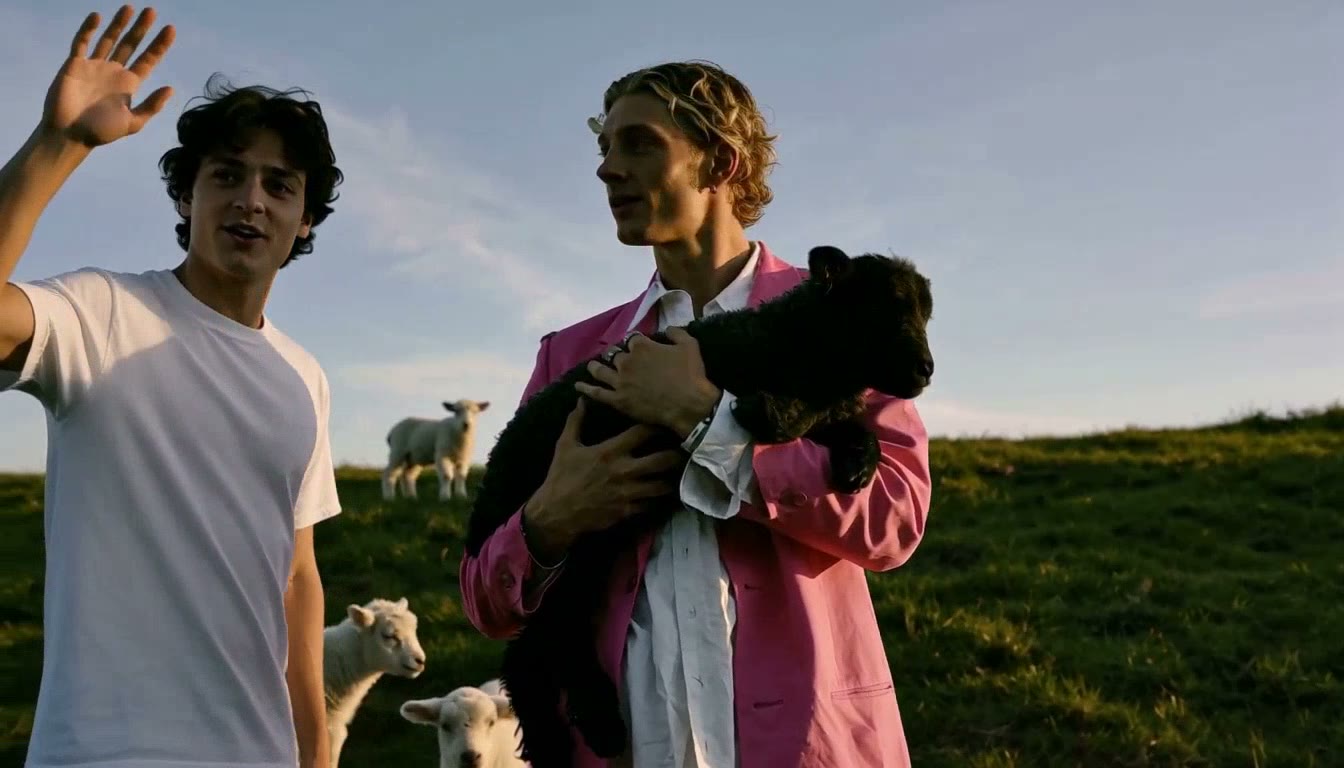
A frame from the launch video, which the team generated with FastH3 Omni on FastVideo.
References by position
The prompt addresses inputs by position, not by filename: <Picture 1>, <Video 1> and <Audio 1>, with numbering that restarts per type. A reference video's own soundtrack is labelled as an audio reference right before its video label, and standalone audio comes last. Because the references ride through every sampling step, the team exposes a sizing choice in ComfyUI: match scales each reference down to the generation's pixel area, while max keeps a 2048 px short edge for identity fidelity at several times the cost.
A 5-second request with one image reference and one voice reference. The dialogue uses the timbre of the audio reference and the audio is generated with the video, not added afterwards.
Eight evaluations instead of fifty
FastH3 Omni is a distilled student of base H3, and the release keeps base H3's text encoder, video VAE and audio VAE; only the diffusion transformer changes. Sampling runs at guidance 1.0 with a video shift of 12.0 and an audio shift of 3.0, which is the same contract the ComfyUI template ships with.
Across 27 matched workloads on eight GB200 GPUs the team reports 5.6 to 11.9 times lower end-to-end latency than base H3, comparing full serving recipes. A selection from the published table, each value a three-seed mean:
| References | Length | Base H3 | FastH3 Omni | Speedup |
|---|---|---|---|---|
| 1 image | 5 s | 35.44 s | 5.67 s | 6.25x |
| 1 image | 15 s | 139.69 s | 14.14 s | 9.88x |
| 1 image + voice | 5 s | 35.92 s | 5.84 s | 6.15x |
| 3 images | 10 s | 131.25 s | 19.15 s | 6.85x |
| 9 images | 15 s | 282.81 s | 41.57 s | 6.80x |
| 1 short clip | 15 s | 140.29 s | 11.76 s | 11.93x |
| 9 images + 3 clips | 15 s | 422.20 s | 59.77 s | 7.06x |
The team also states that on particular FastH3 Omni tasks its UniServe stack reaches real-time generation at 768p for 5, 10 and 15 second clips. The published clips are matched qualitative comparisons, not evidence of output parity with base H3.
 |  |
|---|---|
| Base H3, 35.44 s | FastH3 Omni, 5.67 s |
The same prompt, reference, seed and GPU count for the 1-image, 5-second workload.
An image, a video and a voice reference in one 10-second request: 172.37 s on base H3, 19.75 s on FastH3 Omni.

Nine image references, 5-second request.
Running it in ComfyUI
The ComfyUI repository carries single-file conversions, so no custom node package is needed. Place one diffusion model, one text encoder, the video VAE and the audio VAE:
| File | Size | Notes |
|---|---|---|
fasth3_omniref_8step_pruned_bf16.safetensors | 44.2 GB | reference quality |
fasth3_omniref_8step_pruned_int8_convrot.safetensors | 22.2 GB | matches the official template default |
fasth3_omniref_fp8_comfy.safetensors | 23.1 GB | separate FP8 repo |
qwen3vl_32b_minimax_h3_int8_convrot.safetensors | 27.1 GB | text encoder, BF16 is 51.5 GB and NVFP4 AWQ 15.7 GB |
minimax_h3_video_vae_int8_convrot.safetensors | 2.8 GB | BF16 video VAE is 5.2 GB |
minimax_h3_audio_vae_fp32.safetensors | 0.6 GB | required for generated audio |
The template is video_fasth3_ominiref_r2v, added to workflow_templates on October 20. It uses the core MiniMax H3 Reference to Video conditioning node with autogrow inputs for up to nine images, three videos and three standalone audios, plus the paired video soundtracks, and runs 8 steps, guidance 1.0, MiniMaxH3SigmaShift at 12 for video and 3 for audio at 1344x768 and 124 frames by default.
The model card notes that ComfyUI uses its own model layout, sampler and runtime kernels, so results can differ from FastVideo and UniServe output.
Local and server profiles
- Server: BF16 checkpoint on GB200, B200, RTX PRO 6000 Blackwell and Hopper through UniServe, using its reference-conditioned configurations.
- DGX Spark and RTX 5090: the NVFP4 QAD build, which is trained for NVFP4 execution on Blackwell, with device recipes from the FastVideo cookbook.
- RTX 4090: the FP8 build with layerwise offload, since Ada has no FP4 hardware.
- Decoder: optional NVFP4 VAE decoders in 36-layer quality and 8-layer fast tiers.
ComfyUI also gets an FP8 conversion (23.1 GB) and an NVFP4 QAD conversion (13.8 GB) as separate repositories. The team says a local-AI write-up and release follow on October 21.
In the FastH3 line
Base H3 runs 50 transformer steps for video with audio, which is minutes per clip on a single GPU. FastH3 V2 distilled that to eight steps, Trim removed 8 of the 50 blocks to reach 8 GB cards, and Omni adds the reference path: images, clips and voice on top of the prompt, with the same eight-step budget. FastH3 Omni was post-trained with Nuva Lab and Reactor as preview launch partners, and the release credits the NVIDIA FastGen team.
Comments
Sign in with GitHub to join the discussion.