TaoMate-H3-FL2VA: Streaming First/Last-Frame LoRA for MiniMax H3
Alibaba's TaoLive AIGC team released TaoMate-H3-FL2VA, a 3-step LoRA that adds first/last-frame control to streaming MiniMax H3 generation, with day-one ComfyUI conversions.
The TaoLive AIGC team at Alibaba released TaoMate-H3-FL2VA on October 15, a 3-step LoRA that adds first/last-frame control to the streaming TaoMate-H3 runtime for MiniMax H3 (weights | code). The team calls it "to our knowledge the first real-time streaming first/last-frame-to-audio-video (FL2VA) model": generation is still blockwise and still carries a persistent audio-video KV cache, but the clip now has to land on a chosen last frame as well as start from a chosen first frame.
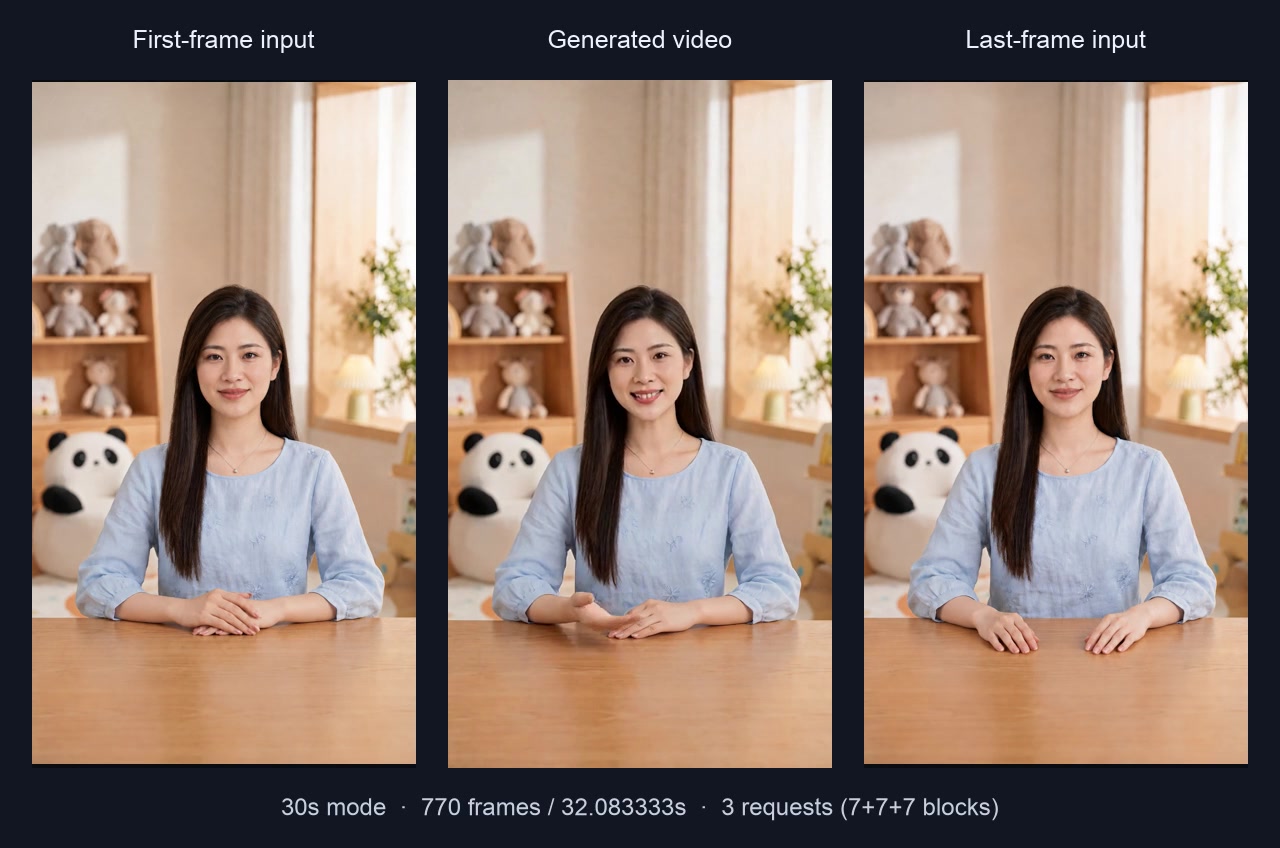
Official preview for the seated_001 FL2VA example: a 30-second streaming clip generated from first and last keyframes.
The earlier T2AV release generated from prompts alone. FL2VA adds a global endpoint deadline to the same runtime, so the three-step denoising blocks have to reach the final keyframe while speech, sound effects and video stay on one synchronized timeline.
Official 30-second comparison for seated_001: 770 frames generated across three continuous streaming requests.
What was released
- FL2VA LoRA adapter at TaoLiveAIGC/TaoMate-H3-FL2VA: rank 128, alpha 128, step-300 online generator weights kept in float32. The adapter ships the same three-file layout as the T2AV release (
config.json,adapter_config.json,adapter_model.safetensors), with optimizer state, EMA and training-only score models excluded. The T2AV adapter was the step-3000 generator EMA checkpoint. - A dedicated FL2VA inference subproject at
src/taomate-fl2avin the TaoMate-H3 repository, with one worked example,seated_001(a seated presentation in a family living room).
--time mode | Output | Streaming requests |
|---|---|---|
--time 30 | 770 frames / 32.08 s | 3 continuous requests, 7 blocks each |
--time 10 | 260 frames / 10.83 s | 1 request, 6 blocks |
--time 5 | 124 frames / 5.17 s | 1 request |
All three modes run at 24 fps and 768x1376 with three-step denoising, a recent-seven clean AV-KV window and one-shot whole-clip decoding. The documented 30-second run uses the step-300 online generator LoRA, an 85-frame final block and a frozen Base10 teacher for audio.
The example case ships its two keyframes, so the conditioning inputs are part of the measured run rather than being described only in the README:
 |  |
|---|---|
| First keyframe | Last keyframe |
Running it in ComfyUI
The FL2VA path already exists in ComfyUI core. The MiniMax H3 Image to Video node takes optional first_frame and last_frame inputs alongside the prompt, width, height and frame length, and returns the positive conditioning plus an audio-video latent; it handles both t2va and fl2va conditioning. No streaming runtime, stage-parallel launcher or multi-GPU setup is needed to use the adapter for local generation. The adapter itself has to be in ComfyUI key layout, and community conversions appeared within hours of the release:
- Kijai's
MiniMax-H3-experimentalrepository carriesminimax_h3_taomate_fl2va_3step_avg_rank_19_bf16.safetensors(about 176 MB), a rank-averaged build placed next to the other MiniMax H3 experiment LoRAs. - austinit/TaoMate-H3-FL2VA-ComfyUI publishes both a full rank-128 BF16 build (1.24 GB) and an average-rank-19 BF16 build (169 MB). The uploader recommends starting at 3 steps, CFG 1.0, LoRA strength 1.0 and the Euler sampler, and reports the smaller build working normally in testing.
- Robert1212star/TaoMate-H3-3Step-ComfyUI, the repository that already hosted the T2AV conversion, added the FL2VA weights in BF16 (about 1.24 GB) on the same day.
Community response
Discussion on r/StableDiffusion leans on the TaoMate 3-step family as an everyday MiniMax H3 accelerator: one commenter calls it the go-to LoRA for "99% of generations", and another reports more natural motion after dropping LoRA strength to 0.6 and switching to the Beta sampler with er_sde. Others prefer the earlier T2AV adapter when using it as a refiner pass. Fast, large movements remain the known weak point of the family: commenters report dances and heavy action shots degrading, which also matches the T2AV write-up. One tester noted that the FL2VA adapter card lists optimizer_step: 300, against step 3000 for the T2AV release, so the new adapter is a shorter run rather than a longer one.
Availability
The official runtime is Linux only and targets NVIDIA Hopper (SM90) GPUs; the repository documents the FL2VA example as a single-node run with TP2 and SP4 sequence parallelism on eight GPUs, and single-node inference for both 4 and 8 GPU configurations. ComfyUI users only need the MiniMax H3 base model plus one of the LoRA conversions above. Reference-to-audio-video (Ref2AV) weights for the same family are still listed as pending.
Comments
Sign in with GitHub to join the discussion.