H3 Anti-Burn LoRA Stops Face Burn in Chained H3 Clips
A rank-32 LoRA for MiniMax H3 continuation clips cuts face burn from +44% to 0% on lightx2v 8-step chains, and from +61% to +4% on an unseen turbo.
diffusion_model.*), so no custom node is needed.
The problem it targets
A long H3 video is usually built by chaining: clip 2 continues from the last frames of clip 1, clip 3 from clip 2, and so on. Each continuation copies the ending it was handed and adds a little more of its own error. After a handful of clips, faces burn: skin and lines turn crunchy and etched, and the whole frame gets harsher.
The LoRA is loaded only on the continuation passes and keeps them close to the look of the first clip, which is generated normally. It is explicitly not meant for clip 1, which has nothing to burn from.
How it is used
- Load it with
LoraLoaderModelOnlyon the model that renders continuation clips only: clip 2 onward. - Start at strength 0.5. Raise it if faces still get crunchier clip by clip, lower it if faces turn soft or waxy.
- Strength depends on the turbo and on the pipeline. Merging the LoRA into an 8-bit checkpoint weakens it, so the recommendation is to try a few values across a 4 to 5 clip chain before settling.
What was measured
Chains of 10 clips, each about 37 seconds long, across four scenes (a kitchen, the same kitchen with a second seed, a park and a porch), averaging all chains per setting. "Face burn" is how much the face's fine texture changed between clip 1 and clip 10: zero means clip 10 is as clean as clip 1, positive means it burned, negative means it went softer than clip 1.
| Turbo | No LoRA | 0.4 | 0.5 | 0.6 | 0.8 |
|---|---|---|---|---|---|
| Unseen model (never trained on) | +61% | +29% | +4% | −13% | |
| HyperFlow 8-step | +25% | +4% | −1% | −14% | |
| lightx2v 8-step v1.0 768p | +44% | +14% | 0% | −7% | −37% |
| Larry Turbo v4 (step 600 EMA) | +261% | +212% | +159% | +57% |
The unseen model column matters most: the LoRA was trained on Larry Turbo v4, HyperFlow and lightx2v, and it still held a fourth turbo it had never seen to +4% at 0.6.
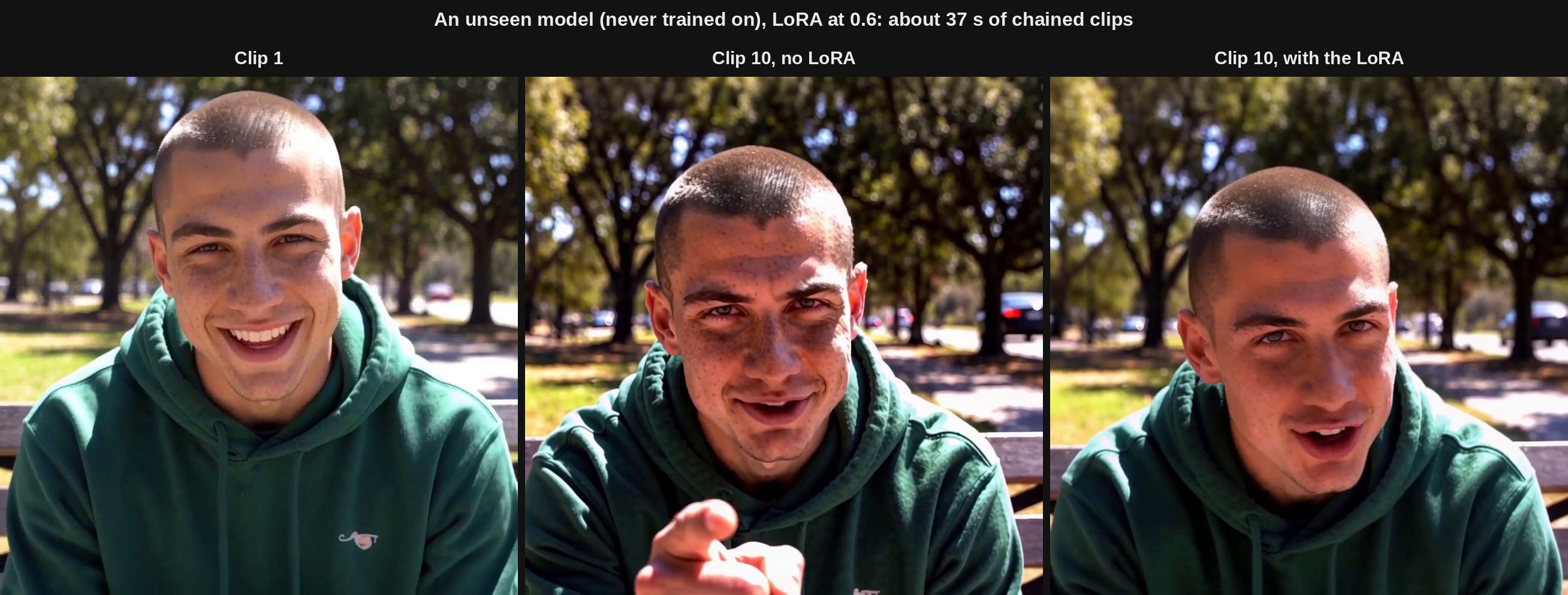
A turbo the LoRA was never trained on. Clip 1, then clip 10 without the LoRA, then clip 10 with it at 0.6. In this scene face burn goes from +51% to −4%.
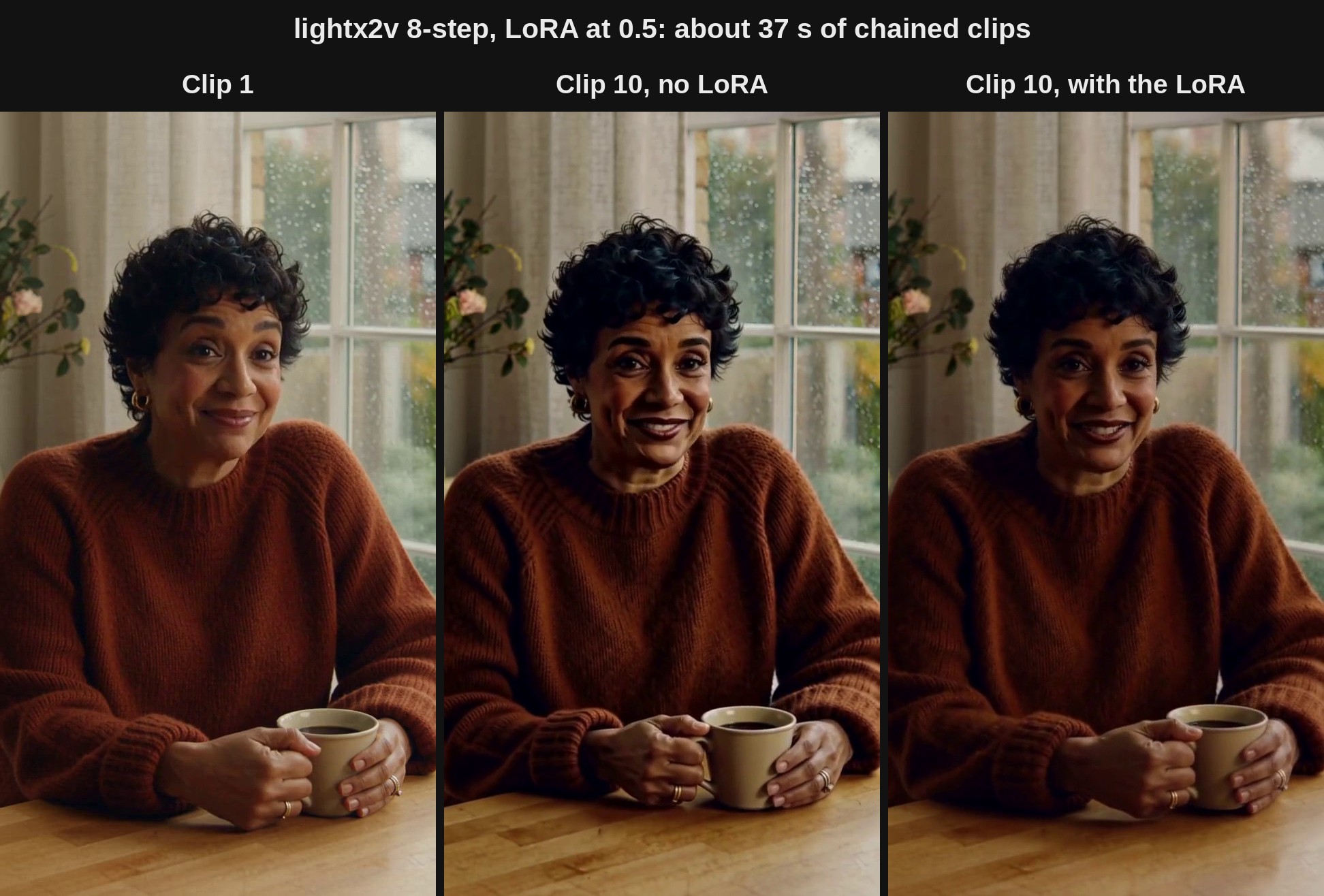
lightx2v 8-step v1.0 768p on the kitchen scene: +52% without the LoRA, +6% with it at 0.5.
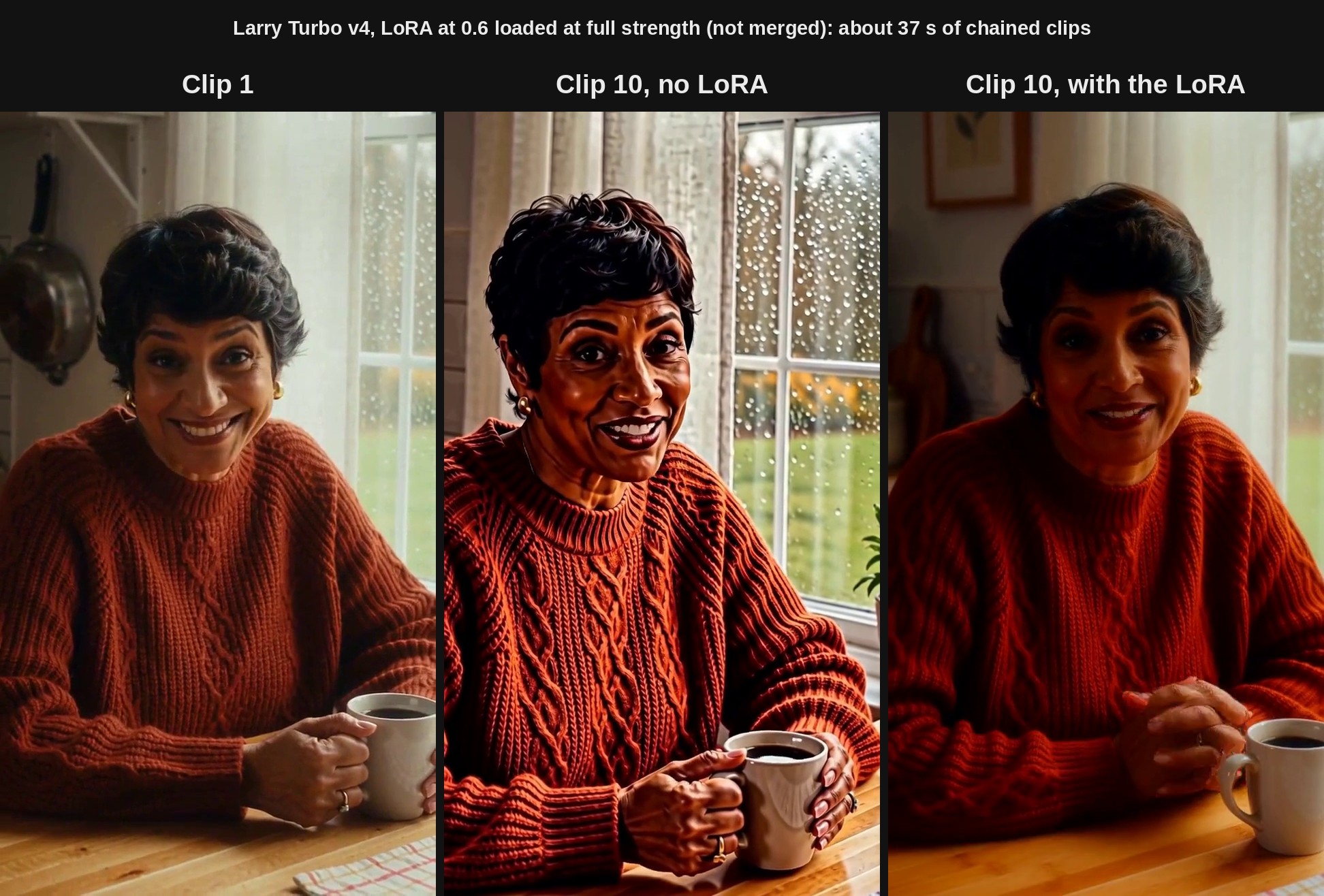
Larry Turbo v4, the hardest burner in the test: +189% without the LoRA, −15% with it at 0.6 loaded at full strength. Larry still softens the image and drifts warmer and darker.
Larry needs more than 0.8 in the merged setup. At 1.0 its face burn was gone (−19%, two chains) but the camera framing started to change; loaded at full strength instead of merged, 0.6 took it from +261% to −5%.
Saturation, skin redness and lip sync stay where they are without the LoRA. Fine detail drops slightly: 4 to 14% below clip 1, against 3 to 18% above it without the LoRA. Too much strength is visible as soft, waxy faces.
The setup behind those numbers
- ComfyUI's int8 ConvRot pruned MiniMax H3 checkpoints from Comfy-Org/MiniMax-H3; clip 1 uses
fl2va, continuations useref2va. - The LoRA is merged with
LoraLoaderModelOnlybefore the turbo LoRA. - Each continuation carries the previous clip's last 39 frames and their audio as a protected masked context.
- 8 steps, CFG 1, at 640×1152, 1152×640 and 864×864.
Other checkpoints (bf16, fp8, GGUF), other step counts and other ways of continuing will want a different strength.
Limitations
The card is direct about the scope. Four scenes per setting is a small test, and a single 10-clip chain can swing ±15 points. It prevents burn but does not repair a video that is already burned. It was only tested on continuations from masked context, not on other ways of extending a video, and only on speaking people with faces at medium to close distance.
How it was trained
Training is trajectory self-distillation. The author recorded what each turbo actually does in a fresh 8-step generation, 150 full-size runs in total, 50 each from Larry, HyperFlow and lightx2v. The LoRA was then trained in continuation mode, with the start of the same video pinned as protected context and the turbo's own fresh run as the target, so a continuation learns to look like a fresh generation instead of amplifying whatever was in its context. There was no synthetic burn and no fresh-noise loss; earlier versions that used them softened everything.
Run settings were 300 steps, rank 32, learning rate 1e-4, network weight 0.6, resolution 864, 124 frames, on a single RTX PRO 6000.
Availability
The adapter is h3_antiburn_universal_v1.safetensors in the Hugging Face repository: 416 tensors, bf16, covering the attention and MLP layers of the 50 DiT blocks and the 2 token-refiner blocks, with no adaLN. Drop it in ComfyUI/models/loras/. The training code, configs and the recorder and scoring scripts are in the h3-antiburn branch of an ai-toolkit fork.
Comments
Sign in with GitHub to join the discussion.