UltraTex: 2K Multi-View Diffusion for 3D Texturing in ComfyUI
UltraTex from Jilin University and VAST textures 3D meshes at 2048x2048 with background token dropping and block-sparse attention, plus a ComfyUI node pack.
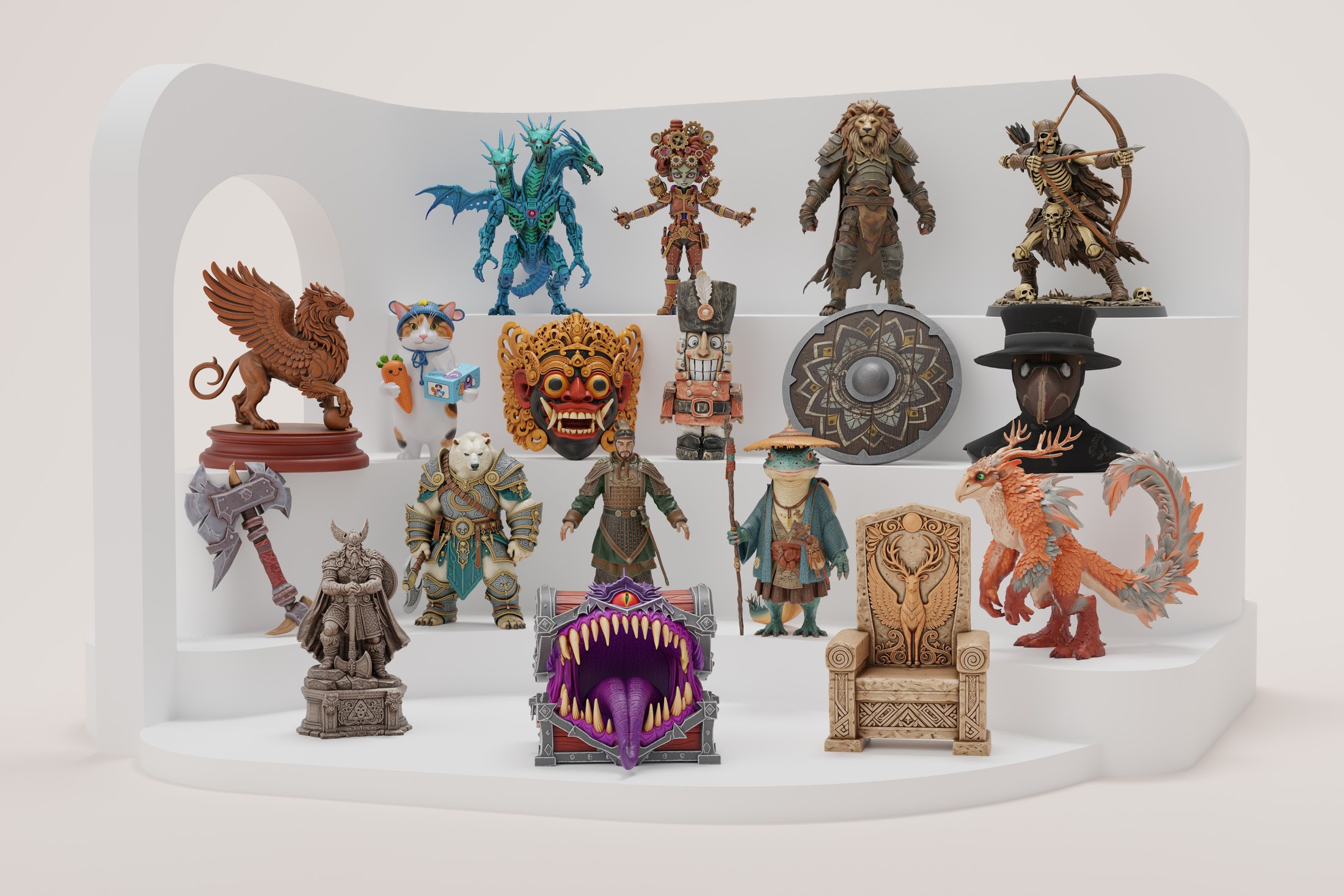
Textured assets produced by UltraTex from an untextured mesh plus a reference image.
What UltraTex does
Give UltraTex an untextured mesh and one reference image and it generates six 2048² texture views (front, left, back, right, top, bottom), then bakes them into a UV texture on the mesh. The point of the paper is that density at 2K is mostly wasted.
Object-centric multi-view rendering has two sources of redundancy: background pixels that carry no useful texture information, and sparse interactions between foreground tokens. UltraTex attacks both:
- Background Token Dropping (BTD) discards background tokens before the DiT backbone, but keeps the original RoPE indices so spatial coordinates and the multi-view geometric prior survive the pruning.
- Block-Sparse Attention (BSA) applies top-k sparse attention over the remaining foreground sequence instead of dense attention.
- Foreground-Aware VAE Decoding replaces the undenoised background latent with a canonical in-distribution background and lightly fine-tunes the decoder, so 2K reconstruction stays free of the artifacts the pruning would otherwise introduce.
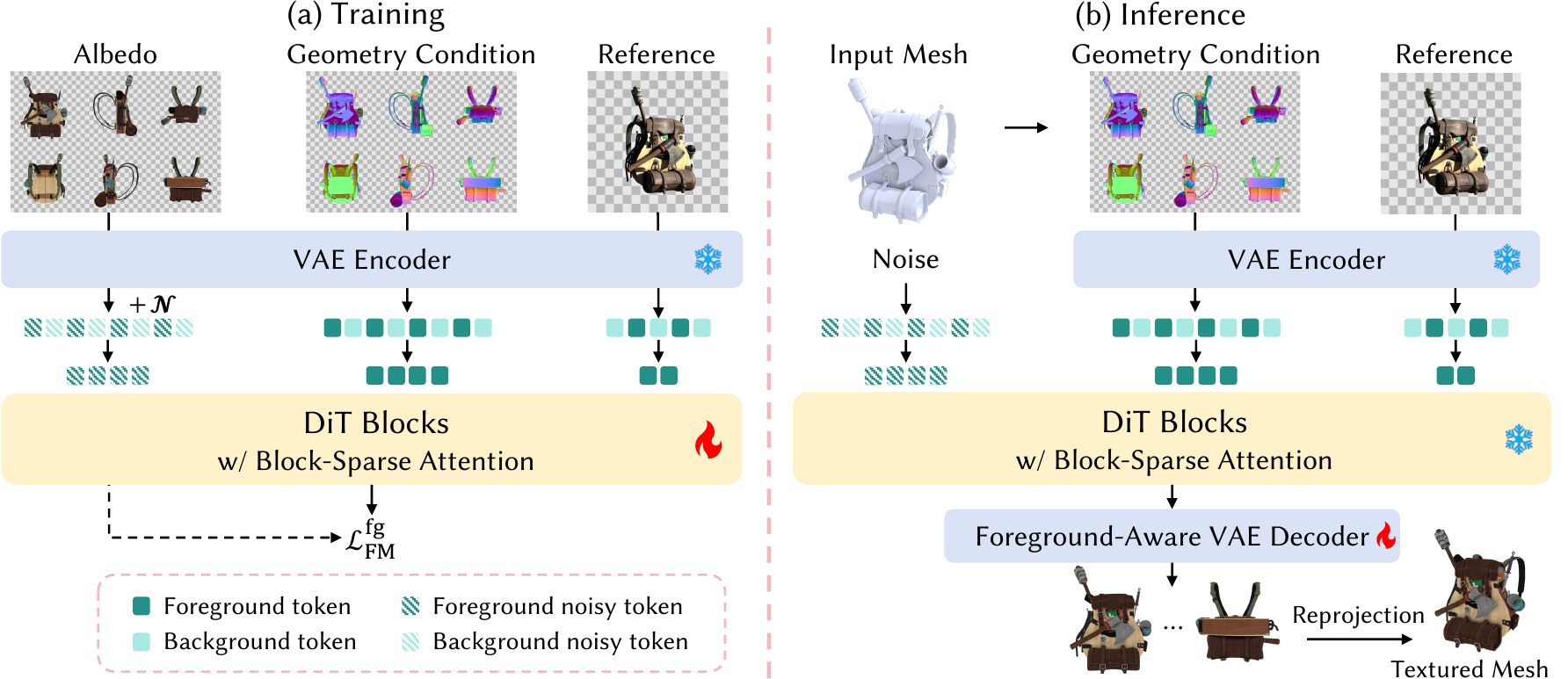
The UltraTex pipeline: background token dropping, block-sparse attention and a foreground-aware decoder.
The backbones are FLUX.1-dev and FLUX.2-Klein (4B and 9B), so the texture generator inherits the prompt and image conditioning of a general image model rather than a purpose-built texturing network.
Where the speed comes from
On common samples in the G-buffer TexVerse dataset, the released implementation reports 20.6× to 91.1× training speedup and 22.3× to 74.6× end-to-end inference speedup over the dense baseline at the same 2K output resolution.
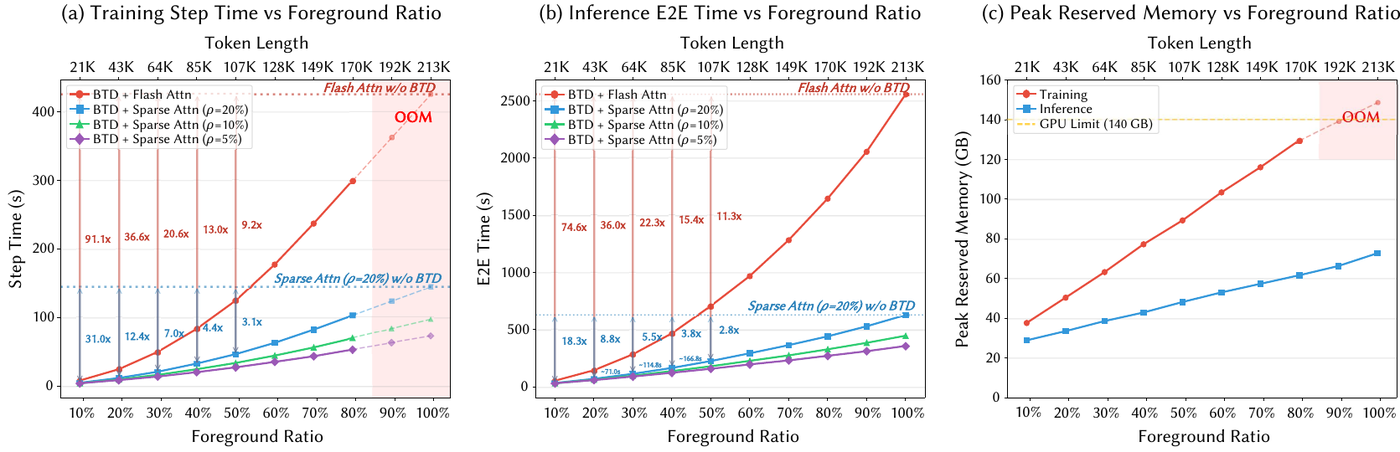
Training and inference speedups over the dense 2K baseline, from the project page.
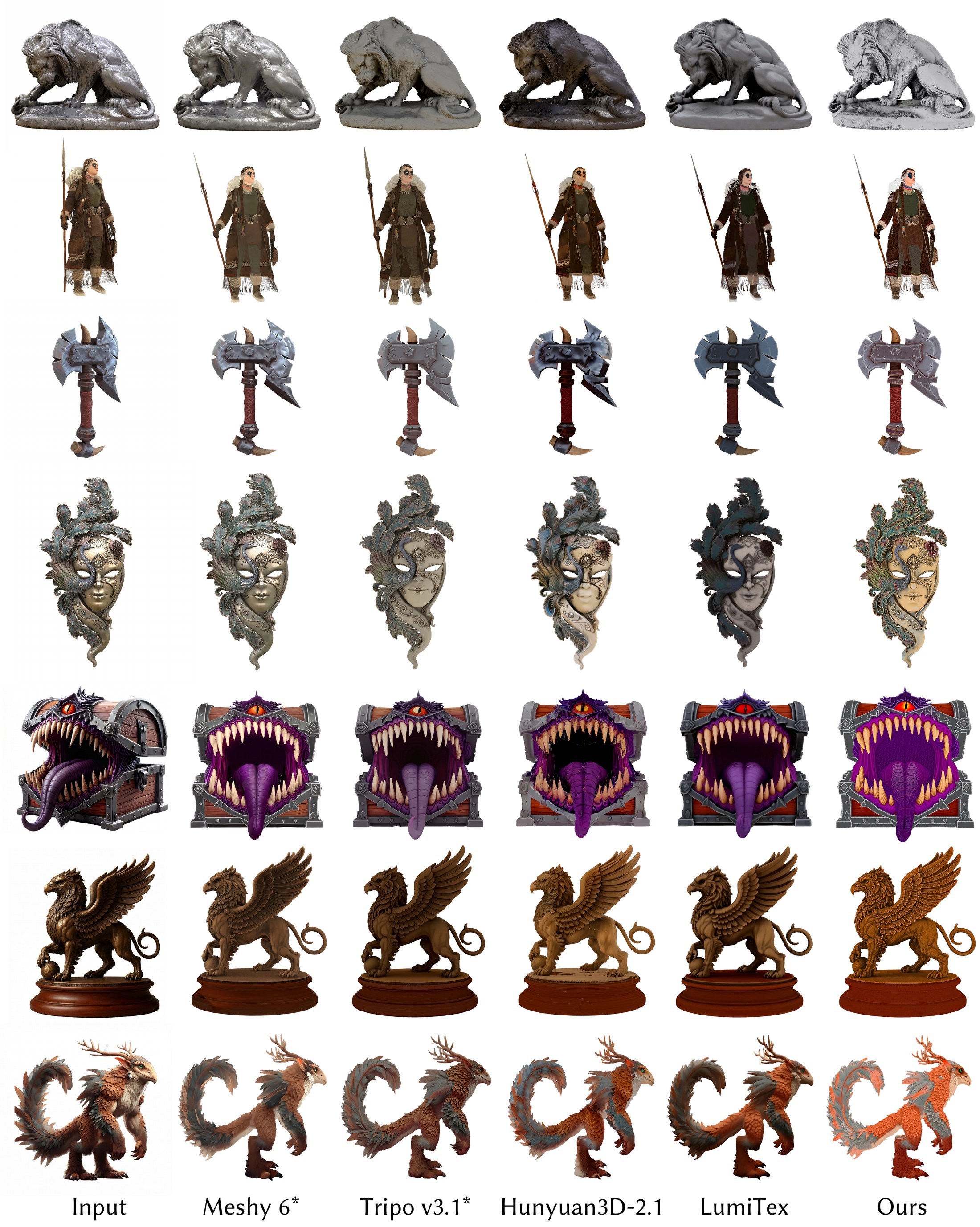
Qualitative texturing results from the paper.
What was released
- Code and weights. Training and inference code are in the UltraTex repository, with checkpoints published on ModelScope.
- Dataset. The G-buffer TexVerse dataset is on Hugging Face.
- Paper. SIGGRAPH Asia 2026, available as arXiv 2609.23169, with results and video on the project page.
Running UltraTex in ComfyUI
Community node pack visualbruno/ComfyUI-UltraTex wraps the pipeline as ComfyUI nodes: UltraTex Load LoRA, UltraTex Foreground VAE Decoder, UltraTex Prep (mesh + reference), UltraTex Sampler and UltraTex Bake Texture. Load LoRA exists because the stock Load LoRA node cannot read these checkpoints (PEFT lora_A.default keys for FLUX.2, UNO processor.*_lora keys for FLUX.1), and Bake Texture back-projects the generated views into a UV texture and returns a GLB that connects straight to Preview 3D.
The diffusion model, VAE and text encoder are loaded with the stock ComfyUI loaders, so fp8 and GGUF weights and ComfyUI's memory offloading apply. Prep offers a GPU UV unwrap (comfy_gpu, around 6 s for 500k faces) or a CPU xatlas path (around 4.6 min for the same mesh).
Four example workflows ship with the node pack:
The other two are PBR at 1024px and FLUX.1-dev.
Availability
The official repository ships PyTorch training and inference code with Triton sparse-attention kernels, and the weights live on ModelScope. The ComfyUI path is the third-party node pack above, not an official Comfy-Org release, so installing it means adding the custom node and pulling the UltraTex LoRA and foreground decoder from ModelScope.
Comments
Sign in with GitHub to join the discussion.