MiniMax H3 ORB360: 360 Camera Orbit and CardSpin LoRAs
MATLOW's ORB360 LoRAs give MiniMax H3 Ref2VA a full clockwise 360 camera orbit around a frozen subject, plus a CardSpin variant that turns the photo itself in space.
ORB360_CW walks the camera a full clockwise turn around a subject that stays frozen in place, and the CardSpin files turn the reference photo itself in space like a thin physical card. The first files landed on September 28, and a higher-resolution step-1500 orbit plus a second CardSpin pass followed on September 30.
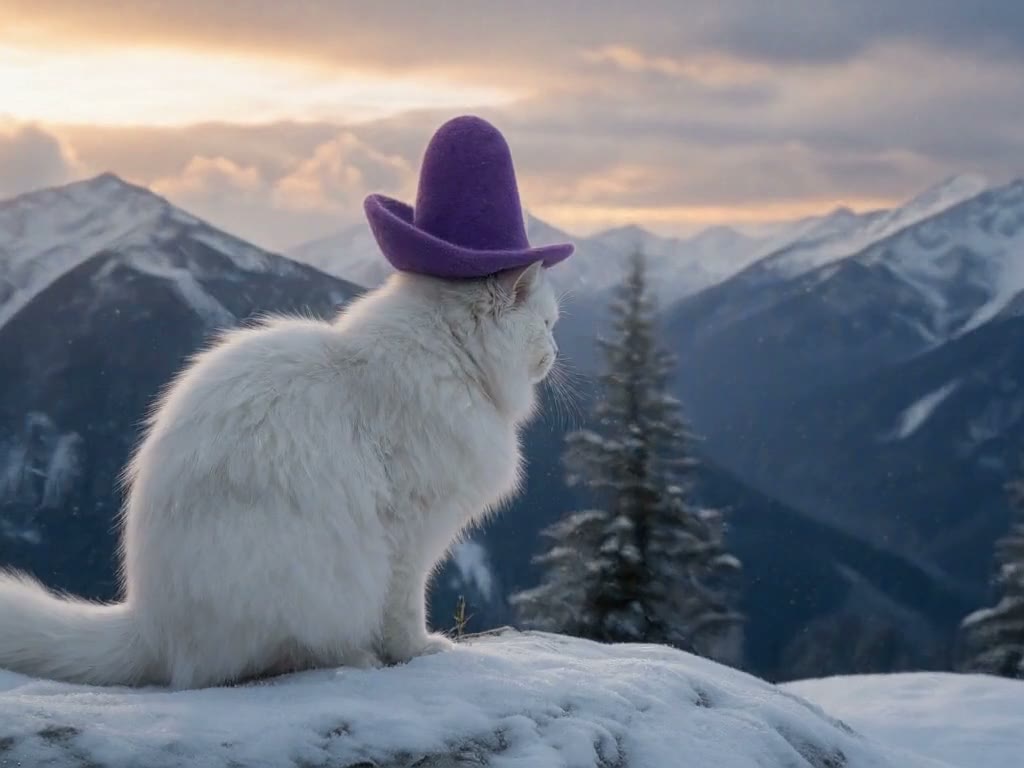
A full turn around a cat in a snowy scene, generated from one reference photo. Source: MiniMax-H3-ORB360-CardSpin.
What the LoRAs do
MiniMax H3 reference-to-video treats its input pictures as appearance references, which is enough for a pose or a look but not for a camera move. ORB360 teaches the model the geometry of a real orbit instead: one turn, one direction, a fixed subject, and a camera that keeps a believable distance and height. The rest of the scene stays where the photo put it.
The step-1500 orbit, 1024 x 768, 124 frames, 20 steps, seed 20260926.
CardSpin starts from the same orbit LoRA and adds 50 training steps on a single generated clip. The result does not orbit the person in the photo any more. It treats the photograph as a flat object and rotates it, which reads as a print or a card hanging in space.
CardSpin v2, the same photo and seed with the card-spin prompt.
Which file to use
| File | What it is | Use it for |
|---|---|---|
minimax_h3_orb360_step1500.safetensors | Orbit LoRA, 1500 steps on high-resolution Blender renders, camera heights from below to above, one to four labelled reference pictures | Clean 360 orbits, the sharpest of the three |
minimax_h3_orb360_cardspin_v2_step50.safetensors | Step 1500 plus 50 card-spin steps | The card spin, starting from the high-resolution orbit |
minimax_h3_orb360_cardspin_step50.safetensors | CardSpin v1, built on the older 750-step orbit | The original card-spin release |
The clip below is the accident that produced CardSpin. While testing the orbit LoRA on real photos instead of the grey-backdrop renders it was trained on, MATLOW fed it an 1867 portrait of Sir John Herschel by Julia Margaret Cameron and the model decided the photograph, not the man, was the object to rotate.
The 750-step orbit LoRA on a 19th century portrait. Source: MiniMax-H3-ORB360-CardSpin.
Fifty steps on a caption of that one clip transferred the effect to photos the training never saw. The high-resolution pass matters more than it looks: the step-1500 orbit roughly doubles fine detail compared with the 750-step version, while the 50 card-spin steps soften everything they touch, so CardSpin is the wrong file to reach for when a clean orbit is what you want.
| White cat 360, same photo, prompt, seed and length | Orbit step 750 | CardSpin v1 | ORB360 step 1500 | CardSpin v2 |
|---|---|---|---|---|
| Fine detail (Laplacian variance) | 30.2 | 19.8 | 56.1 | 20.7 |
| Detail vs step 1500 | 0.54x | 0.34x | 1.00x | 0.35x |
| Edge energy (Tenengrad) | 1098 | 809 | 1343 | 841 |
| First frame vs the photo, PSNR / SSIM | 28.0 dB / 0.87 | 24.5 dB / 0.85 | 28.5 dB / 0.87 | 22.5 dB / 0.77 |
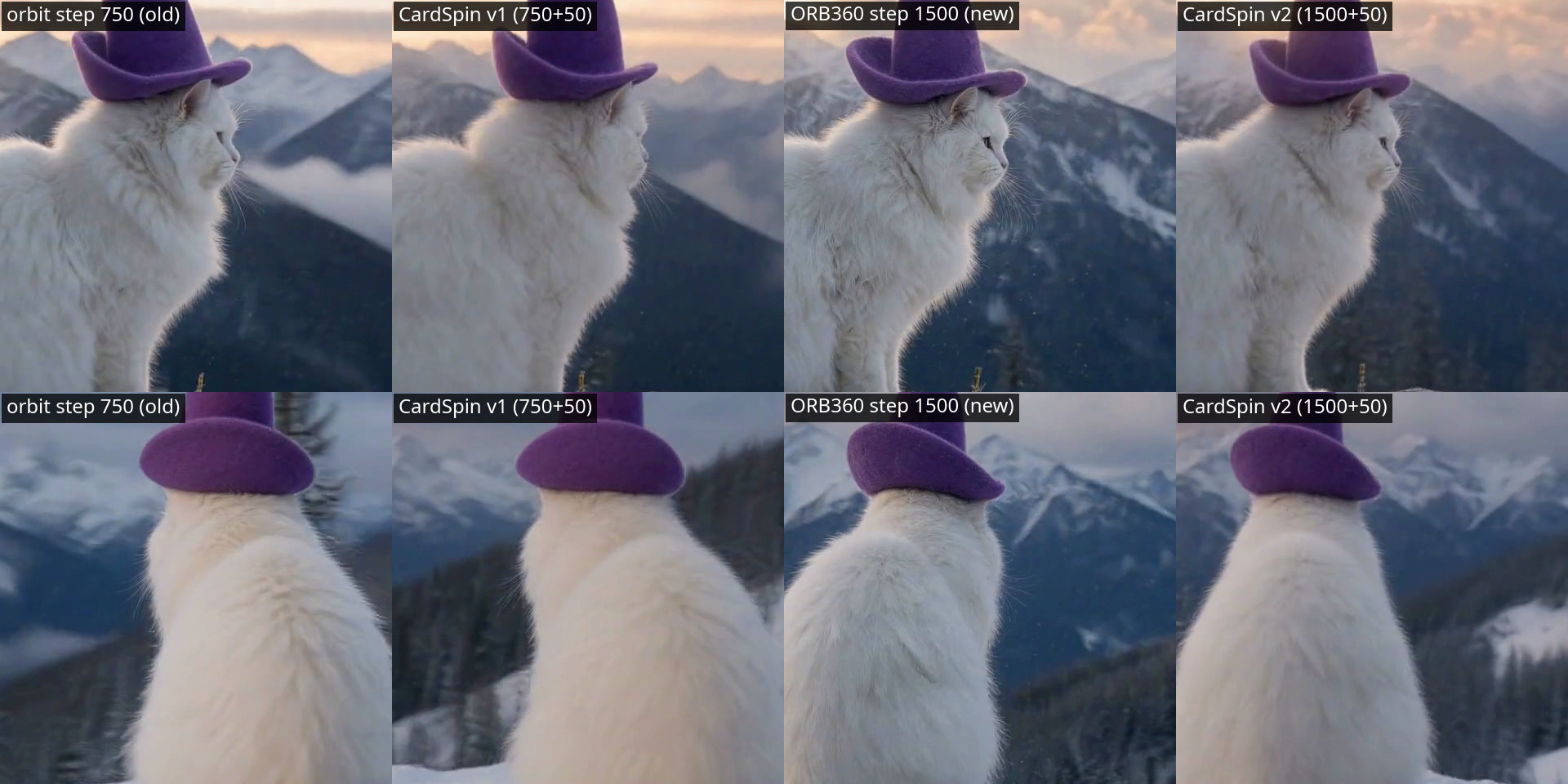
Native-pixel crops of the same frames, one column per LoRA. Source: MiniMax-H3-ORB360-CardSpin.
How well the step-1500 orbit holds up
The author tested step 1500 on three objects that were never rendered for training, one seed each, against Blender renders of the true orbit.
| Test | Result |
|---|---|
| Orbit at 20 degrees, three views (0/120/240) | Within one frame (2.9 degrees) of the true orbit on every frame |
| Orbits from below (30 and 10 degrees below centre, no floor) | Correct height on 118 to 124 of 124 frames, one clean turn |
| Pictures taken from 45 degrees, orbit asked for at 5 degrees | Low orbit on all three objects, most frames within 5 to 10 degrees of the target |
| High orbit (45 degrees) from a single front picture | High orbit, 30 to 45 degrees on most frames, unseen sides invented |
| Pictures taken from 45 degrees, orbit asked for 30 degrees below | Fails, drifts back towards the height of the reference pictures |
| Height changing during the clip, for example 45 above to 30 below | Fails, the object tumbles instead of the camera moving |
Those numbers come from grey-backdrop renders. On real photos the orbit stays at the height of the reference picture for now, which the author lists as the main open problem.
Using the LoRAs in ComfyUI
Both files load with the standard Lora Loader node in model-only mode at strength 1.0, on a MiniMax H3 Ref2VA model. They are kohya-style LoRAs with lora_unet_*, lora_down, lora_up and alpha keys, and all 200 modules map onto the MiniMax H3 weights ComfyUI already loads.
- Feed the reference picture to the Ref2VA conditioning. With one reference the model treats it as the first and last frame of the orbit.
- Keep the clips at 124 frames and 24 fps. The prompts in the repository carry timecodes such as "at 1.708333 seconds (zero-based frame 41), 120 degrees" that assume that length.
- Four prompts ship with the weights: a single-photo orbit that keeps the photo's own surroundings, a three-reference variant for front, 120 and 240 degree views, and the two exact caption formats the step-1500 pass was trained on, taken from held-out tests.
- Resolutions seen working are 800 x 800, 1024 x 768 and 1152 x 768 in landscape, plus 672 x 832 and 832 x 1024 in portrait.
- The captions follow MiniMax's Ref2VA prompt layout and set both audio sections to
N/A, which asks for silence. Without them H3 tends to invent a soundtrack.
Training
Both stages were trained with musubi-tuner at rank 32 with alpha 32, AdamW at a constant learning rate of 1e-4, bf16 mixed precision and video-only loss, on a single NVIDIA RTX PRO 6000. The step-1500 orbit used 23 assets rendered in Blender as 345 one-turn clockwise orbits at three lengths, each clip appearing in three training rows with different reference pictures, for 960 rows and 1500 steps of about 26 hours.
Limitations
- Height control carries over to grey-backdrop renders but not yet to real photos.
- Orbits that change height during the clip fail, and the subject tumbles instead.
- CardSpin output is visibly softer than the step-1500 orbit it is derived from.
- Heights, times and angles in the example captions describe the test objects in the repository and need editing for other subjects.
Comments
Sign in with GitHub to join the discussion.