TaoMate-H3: Alibaba's Real-Time Streaming LoRA for MiniMax H3
Alibaba's TaoLive AIGC team open-sources TaoMate-H3, a 3-step LoRA runtime that streams synchronized audio-video in chunks for 35 FPS long-form MiniMax H3 generation.
Overview
TaoMate is an anchor-guided persistent-memory framework for few-step joint audio-video generation, described in the project's paper and project page. Instead of extending the active context cache, it preserves an immutable visual anchor, compresses completed video and audio blocks into fixed-capacity dynamic states, and retrieves those states through modality-specific residual attention. A reference-aware modulation method conditions video features on anchor appearance statistics, and anchor-preserving causal-context distillation keeps the anchor unperturbed during training.
| Metric | Value |
|---|---|
| Streaming output | 35 FPS |
| Single-device latency | 130.3 s / 1441 frames |
| Backbone | 22.1B (MiniMax H3) |
| Long consistency | 0.9520 |
| Audio desync | 0.000 |
The released runtime generates speech, sound effects, and video on one synchronized timeline, with clean KV-cache handoff that preserves visual identity, voice, and motion across prompt boundaries. Each five-second block can carry its own prompt via a --prompt-json file, and generation runs at 480p, 768p, and aligned 1080p. The validated hardware configuration is 8 x H20 96 GB with tensor and sequence parallelism.
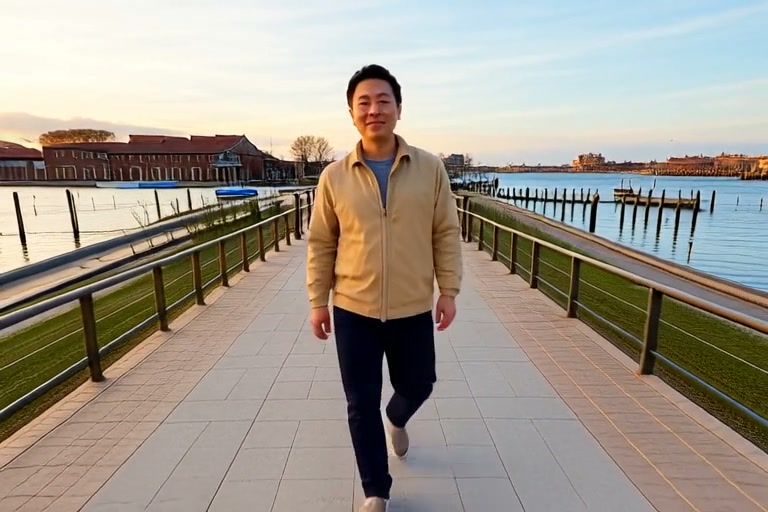
Sample frame from the official demo reel: one narrator character held across streaming blocks.
What Was Released
- Runtime code: the full streaming inference stack at TaoLiveAIGC/TaoMate-H3, including chunked generation, prompt-per-block scheduling, and stage-parallel execution
- 3-step LoRA adapter: the step-3000 generator EMA checkpoint (rank 128, alpha 128, FP32 tensors) at TaoLiveAIGC/TaoMate-H3 on Hugging Face, used with the MiniMax H3 FL2VA base model
- Demo gallery: sample reels including an uninterrupted 30-minute documentary narrator on the project page
Official demo: 10-second clay robot clip generated with synchronized audio.
Community Response
The release has drawn quick attention in the MiniMax H3 community. Within a week it collected 150+ GitHub stars, and community members found a practical two-sampler workflow for single-GPU use: build the scene with a high-step-quality sampler first, then finish the last three steps with the TaoMate LoRA. Testers report strong visual quality without the overcooked look common to other turbo LoRAs, while noting that static or slow scenes work far better than fast motion. A ComfyUI-compatible safetensors conversion of the LoRA is also available from a community member.
Availability
TaoMate-H3 requires the MiniMax H3 base model and targets Linux with SM90 (Hopper) GPUs under the MiniMax H3 community license. The runtime code, installation guide, and prompt-file format are in the GitHub repository, and the LoRA adapter is on Hugging Face. There is no native ComfyUI node for the streaming runtime itself; single-GPU users access the LoRA through community workflows instead.
Comments
Sign in with GitHub to join the discussion.