Rumik OSS 1: 3B Open TTS for 22 Indic Languages
Rumik AI open-sources rumik-oss 1, a 3B text-to-speech model for 22 Indic languages plus English, with code-switched synthesis, delivery conditioning, and inline laughter tags.
<laugh>, <chuckle>, and <sigh> tags. A base checkpoint for community post-training is included, and an interactive Hugging Face demo is live.
Overview
rumik-oss 1 extends tiny aya fire with discrete speech tokens from the mimi codec. Text conditioning and audio generation share a single autoregressive sequence: the model predicts eight codebook tokens per audio frame in codebook order, then the frozen mimi decoder reconstructs the waveform at 24 kHz.
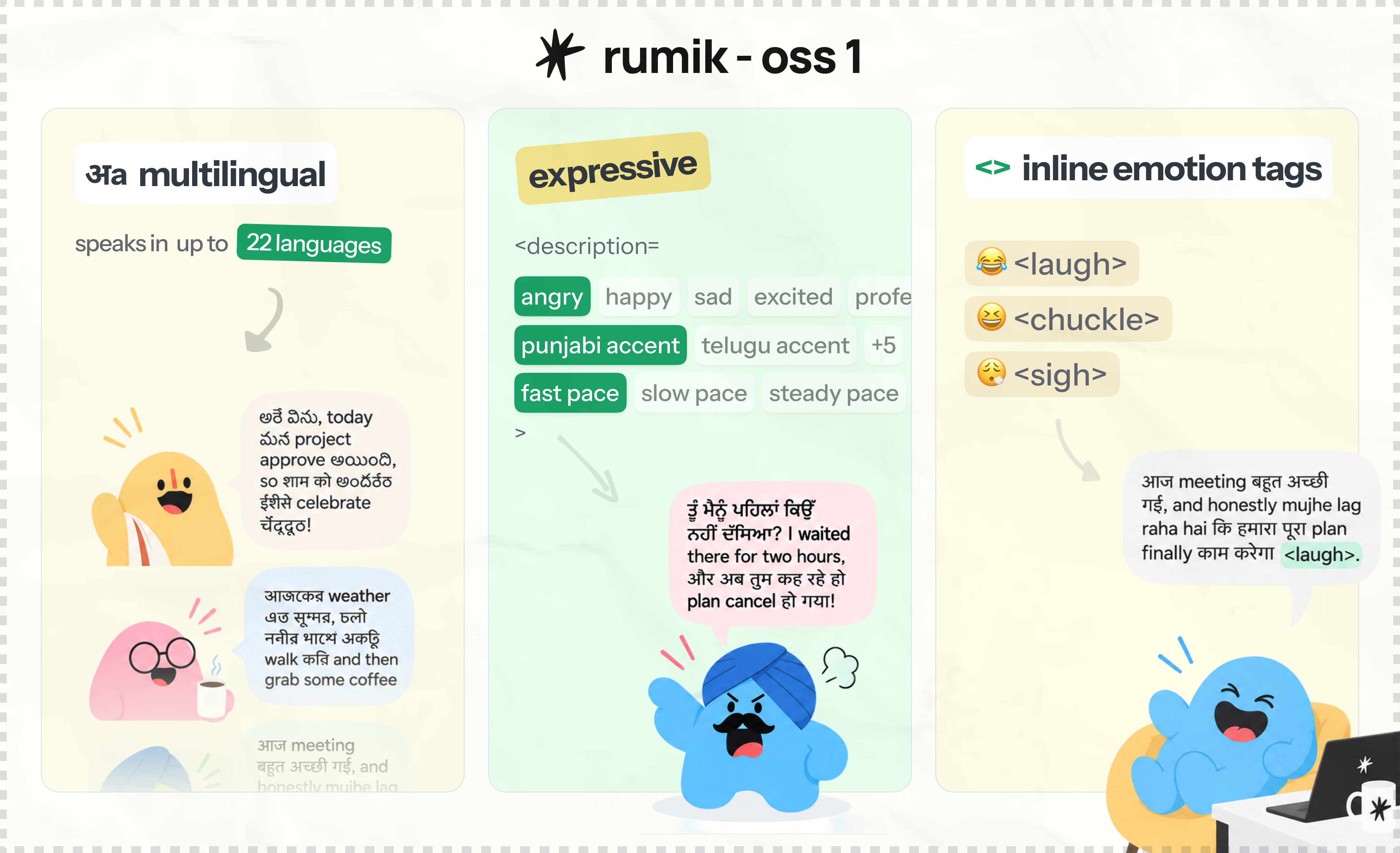
The four shipped voices (Ira, Aisha, Siya, Zoya) each perform across all 22 languages, unlike TTS models that tie a voice to a single language. A <description="..."> prefix controls tone (happy, sad, angry, excited, professional), accent, and pace, and inline tags place laughter, chuckles, and sighs at specific words:
<description="excited, Hindi accent, fast pace"> जल्दी आओ, हमारा नाम लिस्ट में है! <laugh> आज घर में जश्न होगा।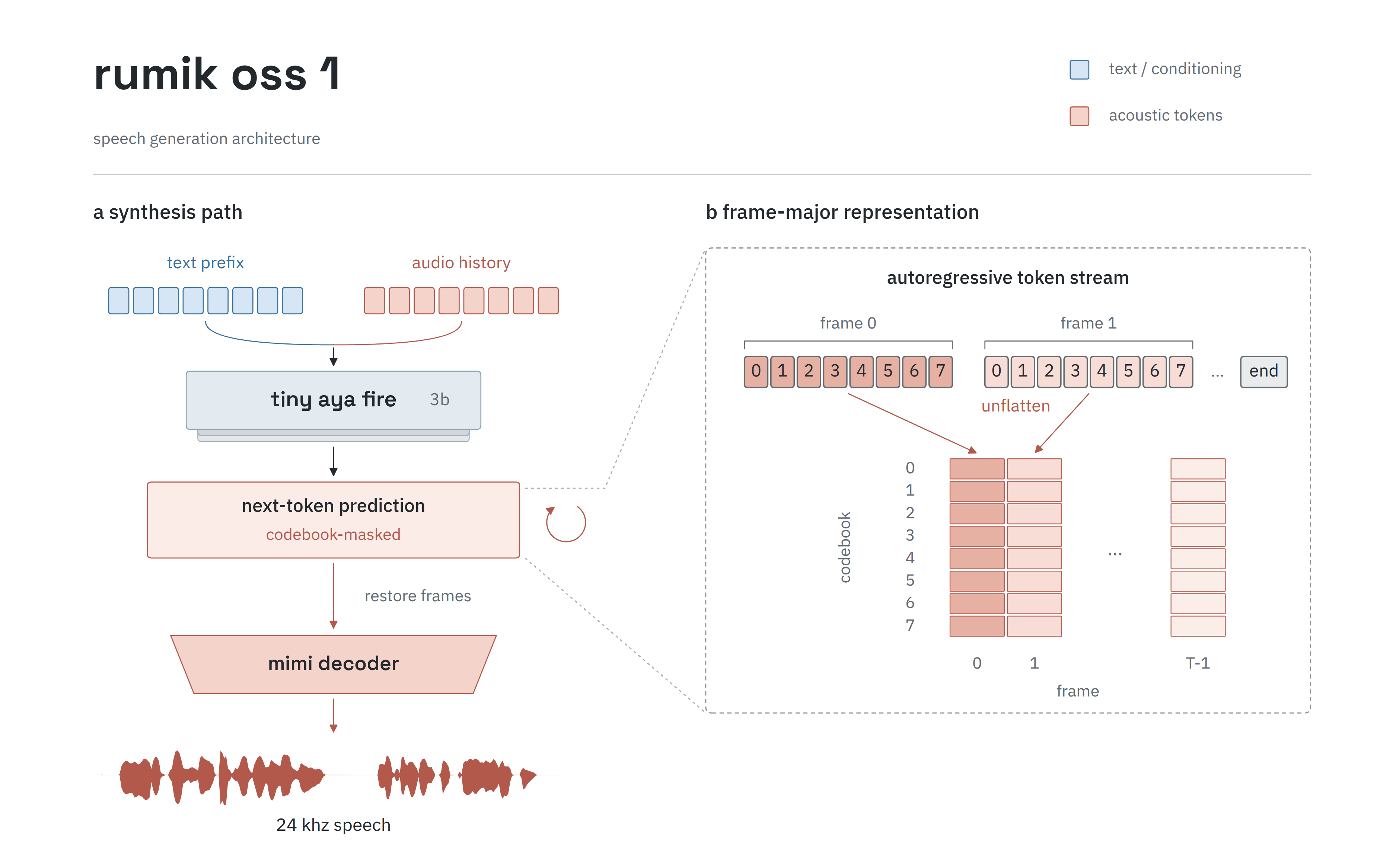
Architecture: frame-major codec-token prediction decoded by the frozen mimi decoder.
Benchmarks
The team released three new benchmarks alongside the model, all with public code and per-sample results:
| Benchmark | What it measures | rumik-oss 1 | Best system |
|---|---|---|---|
| IndicEmo | Expressive delivery in code-switched speech | 2.92 / 5 | Gemini 3.1 Flash TTS (4.58) |
| NoVA | Position-correct rendering of inline vocalizations | 0.884 | Grok TTS (0.972) |
| WER/CER | Transcription fidelity across 15 languages | reported per language | see README |
On NoVA, rumik-oss 1 renders requested laughter and sighs at the right word positions more reliably than ElevenLabs v3 (0.705) and Gemini 3.1 Flash TTS (0.664), trailing only Grok TTS and Inworld tts-2. The README audio samples showcase all four voices across Hindi, English, Telugu, Tamil, Bengali, Kannada, and Punjabi, including code-switched Hindi-English and Telugu-English generation.
Limitations
Training utterances top out at 30 seconds, so the team does not recommend generating utterances longer than 35 seconds, and unrequested vocalizations appear in 2.9-5.4% of outputs. Audio tokens must be decoded by the bundled mimi codec; the standard transformers.pipeline("text-to-speech") path is not supported.
Availability
Weights are on Hugging Face under CC-BY-NC 4.0 (research and non-commercial use) with the separately licensed mimi codec, plus an MLX quantized build for Apple Silicon. A Hugging Face Space runs interactive demos. There is no native ComfyUI integration yet; the model targets Python inference through the repository's one-shot generation example.
Comments
Sign in with GitHub to join the discussion.