Krea 2 Turbo SDA LoRA Restores Sampling Diversity
F16 releases a Krea 2 Turbo LoRA trained with Semantic Directional Alignment: the same prompt now yields different cats, cars and scenes across seeds, with no quality loss.
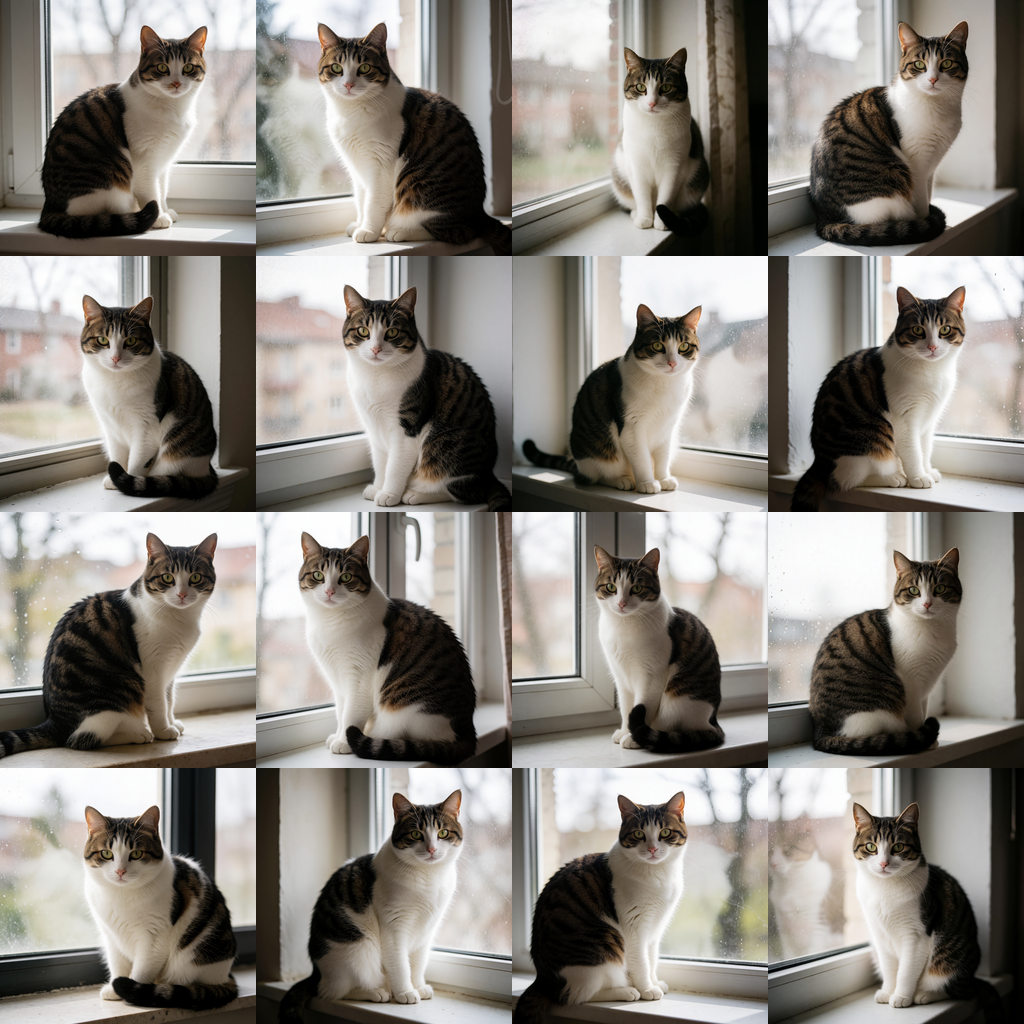
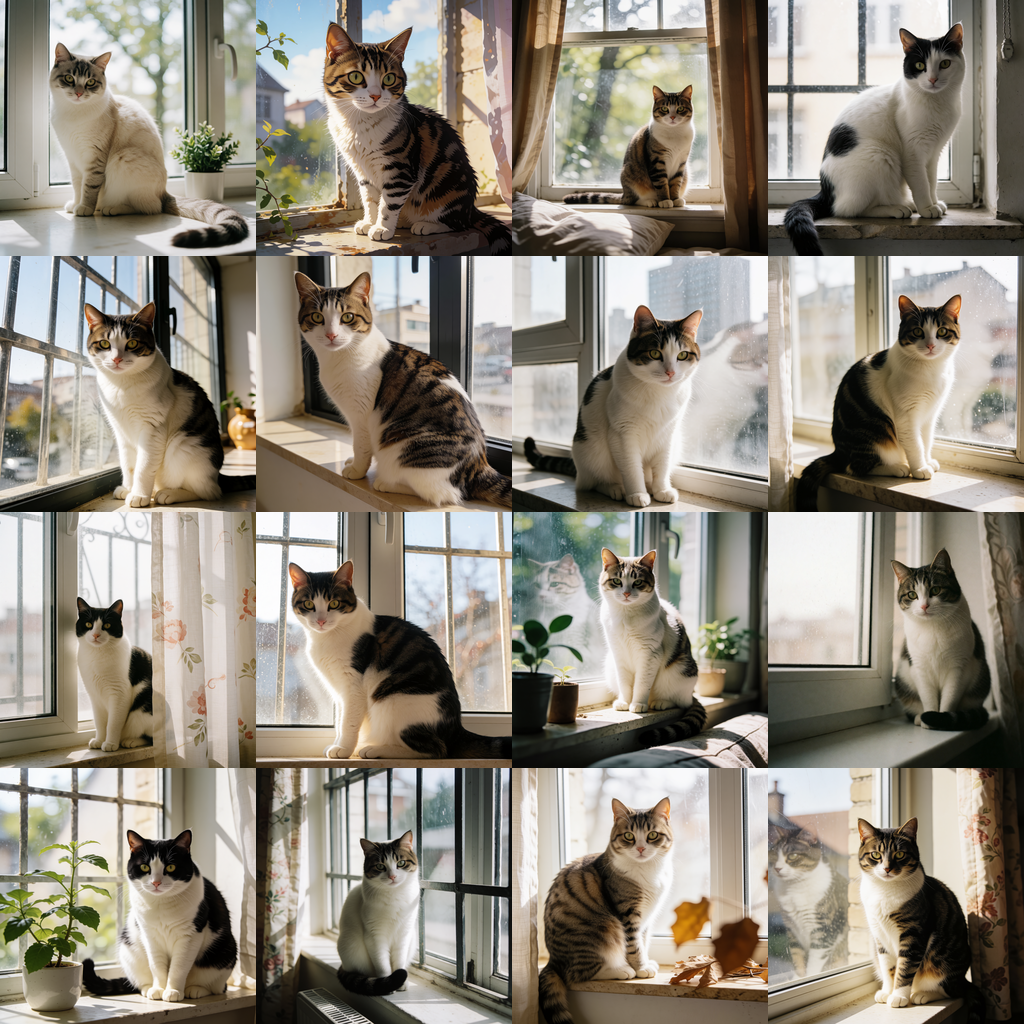
The cleanest illustration is 16 seeds of "a cat sitting on a windowsill". Baseline Turbo redraws the same tabby-and-white cat every time. With the LoRA active, seeds vary fur patterns, lighting, season and even window setting:
 |  |
|---|---|
| Baseline Turbo: same cat 16 times | With the SDA LoRA: varied fur, light and settings |
The same pattern holds for still lifes (one pineapple template vs varied compositions) and portraits (identical studio headshot framing vs different ages, hair and scenes).
How SDA works
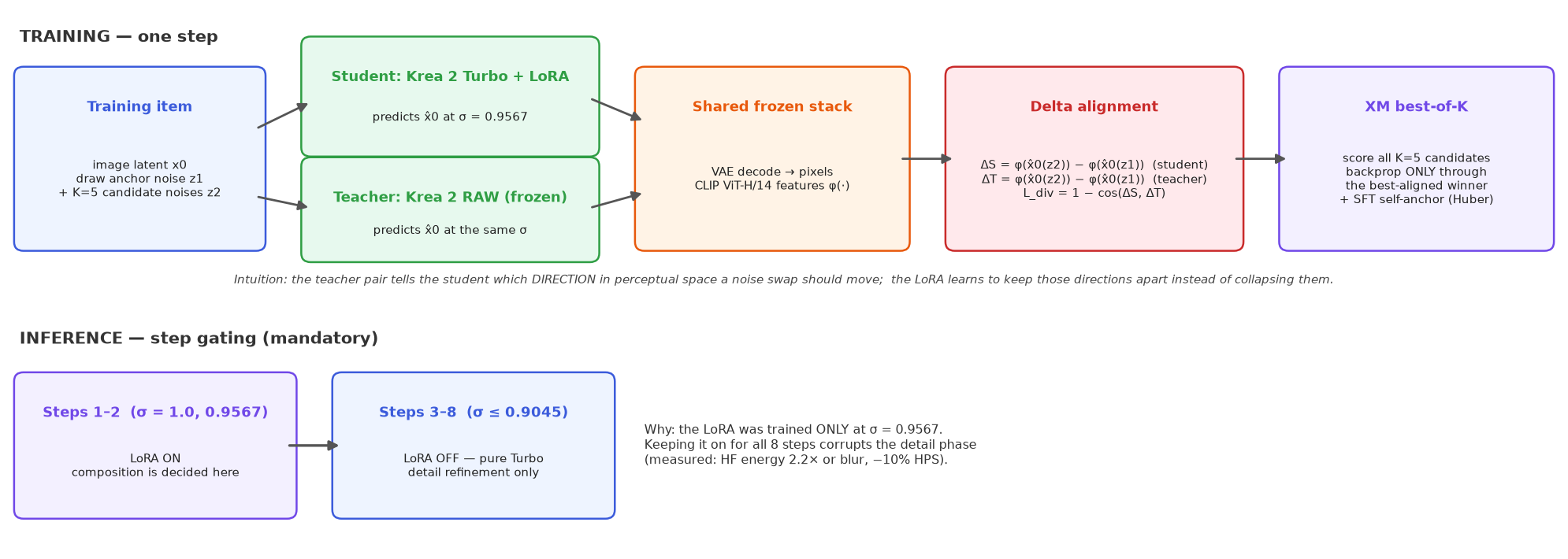
Semantic Directional Alignment treats diversity collapse as a direction problem. For one training image, two random noises are drawn and noisified to sigma 0.9567, the highest learnable step of the 8-step Turbo schedule where composition is decided. The frozen teacher (Krea 2 RAW, the non-distilled parent) and the student (Turbo plus the LoRA) each predict what the image would be for both noises, and a frozen CLIP stack embeds the predictions. The teacher's change in perceptual direction records how a noise swap should move the image; the loss teaches the student's direction to match it instead of collapsing all noises onto one template. A best-of-5 candidate exploration adds roughly 3x learning speed on top.
Training used only 109 images at 1024x1024, which explains how a small adapter can shift composition without drifting style.
The gate matters: 2 steps, then off
The LoRA was trained at a single high-noise node, so it must only be active for the first 2 of the 8 denoise steps. The author's measurements:
| Gate (active steps of 8) | Result |
|---|---|
| 1 | Works, but 20% less diversity |
| 2 | Intended configuration, all numbers above |
| 8 (always on) | Quality collapse: noise or blur, -10% HPS |
Stock ComfyUI applies LoRAs on every step, so a per-step LoRA scheduling node (hooks or scheduling custom nodes) is required to switch the adapter off after step 2. The repo also ships a ready-made workflow, Krea2_turbo_sda_workflow.json, built around the ClownsharKSampler Beta with the gating wired in.
Files
| File | Size | Use |
|---|---|---|
krea2_turbo_sda_v1.0_comfy.safetensors | 447 MB | ComfyUI key format |
krea2_turbo_sda_v1.0_diffusers.safetensors | 447 MB | diffusers Krea2Pipeline |
The diffusers pipeline snippet in the model card implements the gate as a one-line step callback. A Chinese model card is included in the repository.
Comments
Sign in with GitHub to join the discussion.