MiniMax H3 Semantic Bridge: 11MB Adapter for Better Prompt Adherence
An independent distillation project transfers SenseNova U1.5 semantics into MiniMax H3's conditioning space: an 11MB standalone adapter with ComfyUI nodes and workflows.
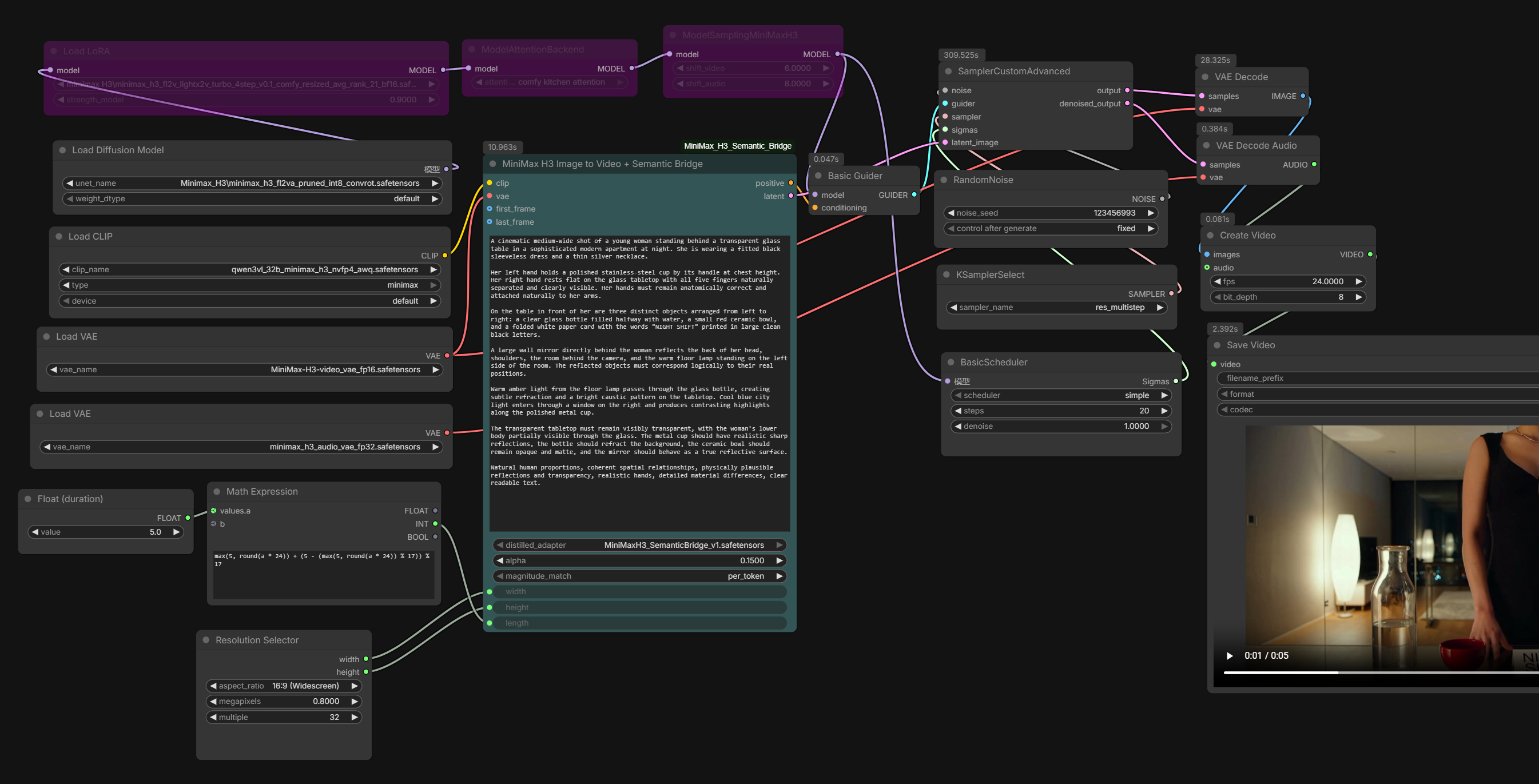
The released example workflow shows where the Semantic Bridge node sits in a standard H3 FL2VA pipeline: after text conditioning, before sampling.
Why not just graft the weights?
The author first tested the obvious approach: directly transplanting transformer weights from SenseNova U1.5 into MiniMax H3. It failed completely. Comparing the relevant 2D weights, H3 has 264 tensors against SenseNova's 593, with zero exact shape matches, zero transpose matches, and zero matching input or output dimensions.
The workable interface turned out to be conditioning representations. H3 consumes 5120-dimensional text conditioning before projecting it into its internal 5376-dimensional transformer space, while SenseNova's language representation is 4096-dimensional. Instead of copying weights, the project aligned how the two architectures represent the same prompt, then distilled that mapping into a compact H3-side adapter.
The research path, fully documented in the repo: hidden-representation alignment reached a validation cosine of about 0.904 on held-out prompts from the original distribution and 0.749 on 160 strict out-of-distribution prompts. A full teacher bridge (running SenseNova at inference time) worked but was impractical, so it was distilled into a student adapter that predicts the teacher-derived representation directly from H3's own conditioning. The final student reaches 0.996 teacher-representation cosine and 0.984 correction cosine, with out-of-distribution correction at 0.990.
What the adapter does in ComfyUI
The adapter is not a LoRA, checkpoint merge, or parameter graft. At inference time it operates only on H3 conditioning: the node transforms native H3 text conditioning into a learned semantic representation, magnitude-matches it, and blends it back as a residual (C = H + alpha * (S - H)), leaving the diffusion transformer weights untouched. SenseNova is not needed at inference.
The node pack (zip on HF) provides three nodes:
- MiniMax H3 Image to Video + Semantic Bridge: a drop-in wrapper around the standard H3 image-to-video path
- MiniMax H3 Semantic Bridge: the conditioning transform itself, with
alpha(default 0.10, A/B examples use 0.15) andmagnitude_match(per-token recommended) controls - MiniMax H3 Clear Semantic Bridge Cache
Installation: extract the zip into ComfyUI/custom_nodes/, put MiniMaxH3_SemanticBridge_v1.safetensors into ComfyUI/models/semantic_bridge/, and restart. The whole adapter is about 11MB.
What it targets: prompt adherence, not new styles
The project focuses on semantic structure rather than adding visual concepts: complex composition, spatial relationships, anatomy, object counting, text constraints, materials and lighting, and reflection or occlusion behavior. The flagship A/B example stresses a prompt that asks for a hand resting flat on a glass tabletop "with all five fingers naturally separated and clearly visible", among many other simultaneous constraints.
 |  |
|---|---|
| Native H3: the right hand drifts across the tabletop | Semantic Bridge (alpha 0.15): the hand stays resting as prompted |
Second half of the glass-table A/B pair with the bridge enabled (alpha 0.15).
The author is explicit that these are qualitative observations from controlled pairs, not a benchmark: the adapter may help some prompts, do little on others, or occasionally make results worse. The representation-space metrics do not translate directly into perceptual quality gains.
Scope: FL2VA only, and a 24GB development rig
Two practical notes. First, v1 works only on the standard FL2VA / text-conditioned path. A Ref2VA-compatible variant was tested and degraded reference-audio singing and lip sync, so the README explicitly warns against using it for reference-conditioned generation.
Second, the entire project (representation extraction, bridge experiments, distillation, evaluation) ran on a single RTX 3090 Ti with 24GB, with no multi-GPU cluster. For an experiment about transferring learned behavior between incompatible architectures, that is arguably the most interesting part of the release.
Availability
- Adapter, nodes, workflow, research materials: speach1sdef178/MiniMax-H3-Semantic-Bridge on Hugging Face
- License: model-derived artifacts follow the MiniMax H3 Community License (with NOTICE included); the SenseNova U1.5 teacher is Apache-2.0 and is not redistributed
- Full research write-up: RESEARCH_ARTICLE.md
Comments
Sign in with GitHub to join the discussion.