VDN-H3: Hybrid Attention Runs MiniMax H3 Video Faster Than Playback
OpenVDN's Video DeltaNet hybrid attention checkpoint for MiniMax H3 renders a 14.4s 768p clip in 8 steps, with a community ComfyUI port already available.
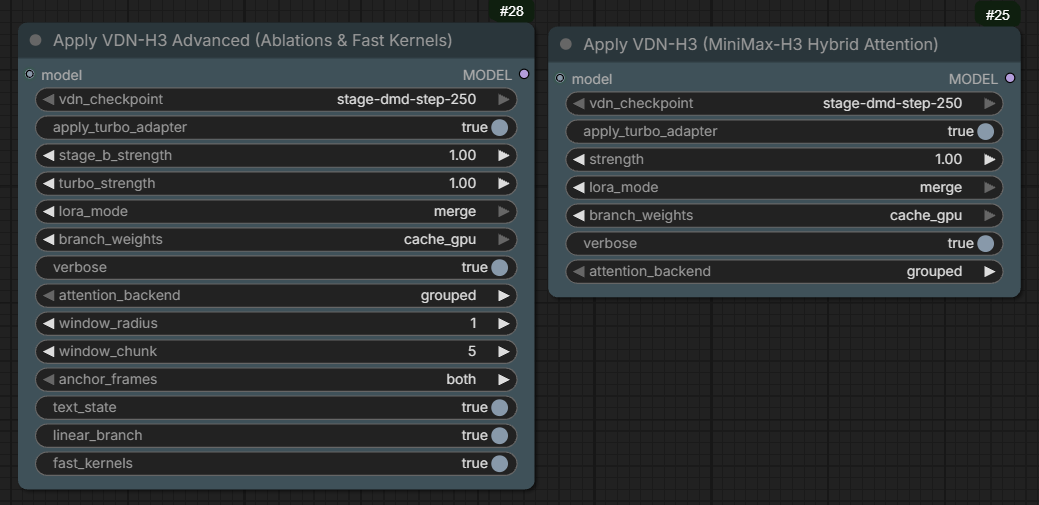
The community ComfyUI port runs the released VDN-H3 checkpoints as runtime model patches on ComfyUI's native MiniMax-H3 node, with no core modifications.
How Video DeltaNet speeds up H3
On a frontier omni-model like MiniMax H3, softmax attention over long token sequences accounts for more than 85% of total runtime, and its cost grows quadratically with clip length. Video DeltaNet splits video-video attention into two complementary branches: a bidirectional sliding-window softmax branch that keeps exact attention between nearby frames (fine detail and short-term stability), and a bidirectional linear-attention branch that carries long-range context through a constant-cost recurrent state. A 4-way boundary-anchor scheme adds only 3.57% attention density while keeping global consistency, so the first and last frames of a clip remain visible to every frame.
The checkpoint does not replace the H3 backbone. It ships a separate linear-attention branch plus two small LoRA adapters that merge into the backbone during inference, leaving the original weights untouched. Alongside the architecture change, the 8-step model is a DMD distillation of the 50-step model.
Performance and quality
The headline numbers come from the datacenter configuration: on 8 B200 GPUs, VDN-H3 generates a 14.4-second 768p clip in 11.23 seconds in 8 denoising steps. Single-GPU comparisons against the dense H3 baseline:
| Configuration | GPUs | 50 NFE (VDN-H3-50-step) | 8 NFE (VDN-H3-8-step) |
|---|---|---|---|
| dense MiniMax-H3 (H200) | 1 | 27.3 min | 4.4 min |
| VDN-H3 FP8 (H200) | 1 | 9.4 min | 90.5 s |
| dense MiniMax-H3 (B200) | 1 | 13.95 min | 2.23 min |
| VDN-H3 FP8 (B200) | 1 | 5.3 min | 51 s |
The team reports the hybrid model is visually near-indistinguishable from dense H3 output and shows higher quality and better instruction-following than MiniMax FastH3. Sample comparisons, including side-by-side clips against dense H3 and FastH3, are on the project page.
VDN-H3 8-step output sample from the project page.
Running it in ComfyUI
The official release targets a datacenter stack: 8x B200 with Ulysses sequence parallelism and FlashAttention-4 kernels that only support Hopper and datacenter Blackwell. There are no official Windows builds, and consumer Blackwell (sm_120) is not supported by the FA4 kernels.
The ComfyUI-VDN-H3 port reproduces the official hybrid-attention math as runtime model patches on ComfyUI's native MiniMax-H3 model, substituting portable PyTorch equivalents for the FP8 linears and fused Triton kernels. It is unit-tested against the official implementation and needs zero new dependencies. To install:
- Clone the repo into
ComfyUI/custom_nodes/and restart ComfyUI. - Download the checkpoint stage you want into
ComfyUI/models/vdn/, keeping the directory layout intact (model_spec.json,linear_branch/,adapters/):
hf download OpenVDN/vdn-minimax-h3 --include "stage-dmd-step-250/*" --local-dir <ComfyUI>/models/vdnThe 8-step stage-dmd-step-250 download is roughly 5 GB (linear branch plus adapters); the 50-step stage-b-step-2000 variant is about 4.3 GB.
What the port does not give you is the headline speed: the official 74.5x figure combines 8-GPU parallelism, FA4, FP8, and 8-step distillation. Upstream's own single-GPU measurement is about 2.6x at 50 steps, and the port's portable kernels land somewhat under that (measured around 17 s/it at 1280x736 / 145 frames on an RTX 5090). Community benchmarks in the Banodoco H3 channels timed the 8-step VDN-H3 Turbo at 2:04 for 1280x736 versus 1:24 for the LightXv2 4-step turbo on the same hardware, with commenters noting VDN holds fast motion better than the FastH3 route.
Same prompt with dense H3 at 50 steps (top of the comparison on the project page).
Availability
- Weights: OpenVDN/vdn-minimax-h3 on Hugging Face (MiniMax H3 Community License; note it excludes some territories)
- Official code: OpenVDN/vdn-minimax-h3 (Apache-2.0), with inference and training code and a project page
- ComfyUI port: Saganaki22/ComfyUI-VDN-H3
Comments
Sign in with GitHub to join the discussion.