ComfyUI-MiniMaxH3-CLIPCached: Disk Cache for H3 Conditioning
A new ComfyUI node caches MiniMax H3 Qwen3-VL conditioning to disk: repeat runs with the same prompt skip the 14.6 GB encoder, dropping conditioning from 29.9 s to 1.1 s.
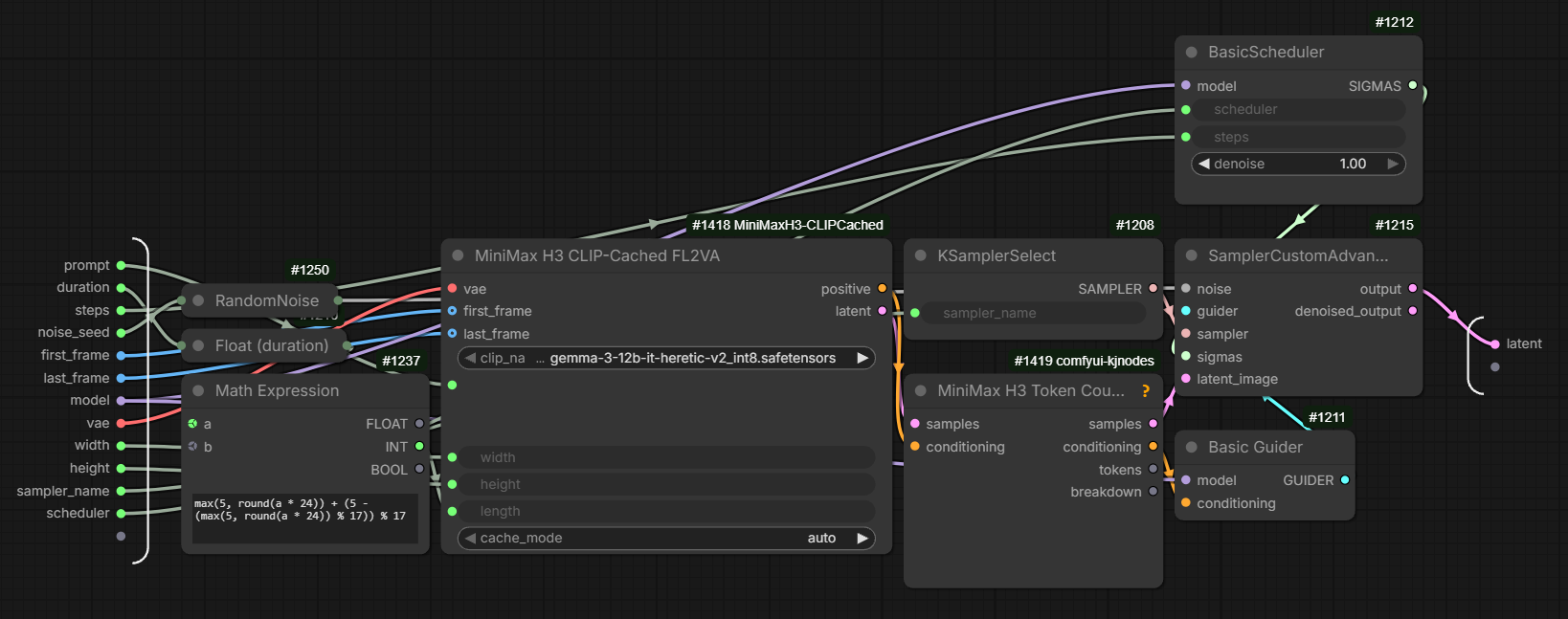
The cached node replaces the stock H3 conditioning node; the diffusion stage is untouched.
What it caches, and what it does not
This is not a sampling accelerator. It is not TeaCache or FirstBlockCache, and it does not touch sampling steps. The node replaces ComfyUI's stock H3 conditioning node: on a cache hit it loads previously computed text/vision conditioning from disk instead of running the Qwen3-VL encoder, and the diffusion stage proceeds unchanged.
| Change | New cache entry? |
|---|---|
| Prompt text | Yes |
| Encoder checkpoint | Yes |
| Keyframe/reference pixels visible to the encoder | Yes, when encoder-visible content changes |
| Seed, sampler, scheduler, steps | No |
| Downstream LoRA or strength | No |
That split matters for iterative workflows: if you rerun the same prompt tweaking only sampler settings or LoRA weights, every run after the first is a hit.
Measured numbers
The author's controlled benchmark (5 cases per mode, medians, RTX 5080 16 GB under WSL2, deliberately cold encoder reads for native and miss):
| Mode | Conditioning | Peak VRAM | Peak process RAM |
|---|---|---|---|
| Native | 29.85 s | 15.24 GiB | 29.25 GiB |
| Cache MISS | 32.23 s | 15.24 GiB | 28.25 GiB |
| Cache HIT | 1.12 s | 2.67 GiB | 3.38 GiB |
A miss is intentionally not a fast path: it still runs the encoder and writes the result to disk, costing about 2 extra seconds. But after the encode the encoder is unloaded instead of staying resident, so sampling runs with that memory freed. In the author's screenshot, native keeps both the 11.7 GB H3 model and the 14.6 GB encoder resident while sampling, while a cache hit leaves only the DiT loaded and process RAM drops from 40 GB to 25.5 GB.
Nodes and cache management
The pack includes cached counterparts of the stock H3 Image-to-Video (FL2VA) and Reference-to-Video (Ref2VA) nodes, plus dual-resolution variants that prepare conditioning for both the base pass and an upscale target, and a shared encoder-name selector.
Every unique conditioning request becomes a cache entry that persists until deleted, and they add up if you iterate a lot. A built-in cache manager panel handles browsing, tagging and pruning entries. Requirements are ComfyUI 0.30.0 or newer with the native H3 nodes.
Availability
The node is in ComfyUI Manager and the registry as minimaxh3-clipcached, or clone the repository into custom_nodes. The current version has no automatic cache eviction, Ref2VA uses fixed reference slots, and GGUF encoders are untested.
Comments
Sign in with GitHub to join the discussion.