MiniMax H3 Turbo-SLA: 4-Step FL2V Sparse Attention LoRA for ComfyUI
Lightx2v releases MiniMax H3 Turbo-SLA, a 4-step FL2V distillation with 85% sparse attention, about 2.5x faster on RTX 5090, in LightX2V and ComfyUI formats.
The Lightx2v team released MiniMax H3 Turbo-SLA, a 4-step distilled first/last-frame-to-video (FL2V) checkpoint for MiniMax H3 that combines fast distillation with SLA (Sparse-Linear Attention) for more efficient inference (Hugging Face).
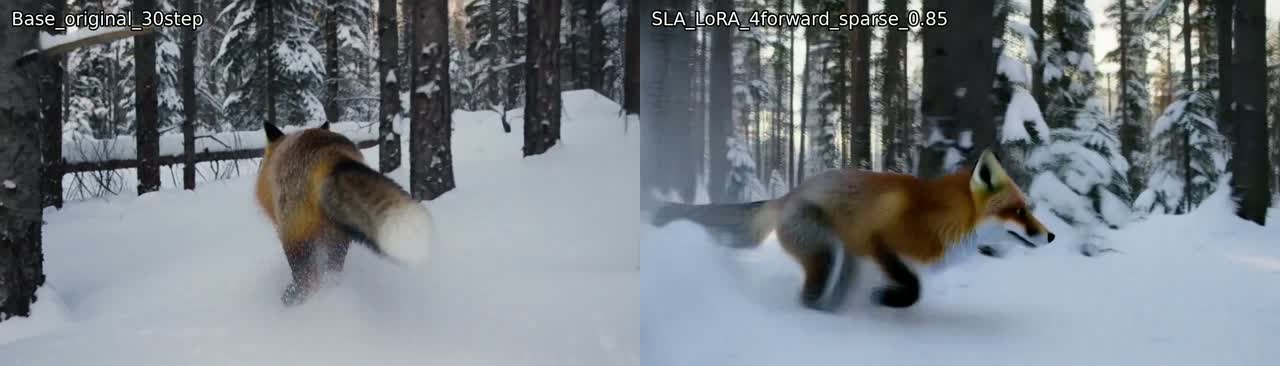
Side-by-side comparison between the 30-step MiniMax H3 base model and the 4-step Turbo-SLA model
The model uses an 85% attention sparsity ratio. In the tested LightX2V setup it delivers approximately 2.5x inference acceleration on an NVIDIA RTX 5090 while retaining competitive visual quality, and it supports 768p FL2V generation.
What's in the release
The repository ships two BF16 checkpoints of the same 4-step FL2V LoRA:
| Checkpoint | Format | Description |
|---|---|---|
minimax_h3_fl2v_turbo_4step_v0.1_768p_sla_bf16.safetensors | LightX2V | Native BF16 LoRA checkpoint for LightX2V inference |
minimax_h3_fl2v_turbo_4step_v0.1_768p_sla_comfyui_bf16.safetensors | ComfyUI | Converted BF16 LoRA checkpoint for ComfyUI workflows |
Both checkpoints require the original MiniMax-H3 model weights. The LightX2V inference path uses a dedicated SLA configuration with attn_type: dynamic_sparse_attn, an 85% sparsity ratio with the sage2 operator, and 6.0/3.0 video/audio flow shifts.
ComfyUI usage
MiniMax H3 has native ComfyUI support, so no custom node is required for the LoRA:
- Download
minimax_h3_fl2v_turbo_4step_v0.1_768p_sla_comfyui_bf16.safetensorsintoComfyUI/models/loras/. - Load the base MiniMax H3 checkpoint in a FL2V workflow and apply the LoRA between the model loader and the sampler.
- Run 4 sampling steps at 768p resolution (for example 1344x768).
This release continues the Lightx2v Turbo line: the earlier 4-step v0.1 and v1.0 8-step / 768p checkpoints remain available, and the SLA variant adds a sparse-attention path for users who want the extra speed on top of 4-step distillation.
Comments
Sign in with GitHub to join the discussion.