MiniMax H3 Single-Frame VAE 500K: Sharper Single-Image Decoding
iamkaikai trains the H3 image decoder for 500K steps, producing a single-frame VAE checkpoint that decodes one image per H3 latent slice with sharper, more coherent output.
iamkaikai released an independent, experimental decoder-only checkpoint for MiniMax H3: the Single-Frame VAE 500K decodes one image from a single H3 temporal latent slice (Hugging Face). It continues the work of Mamad8's image-specialized H3 VAE, with 500,000 additional training steps on image-reconstruction examples.
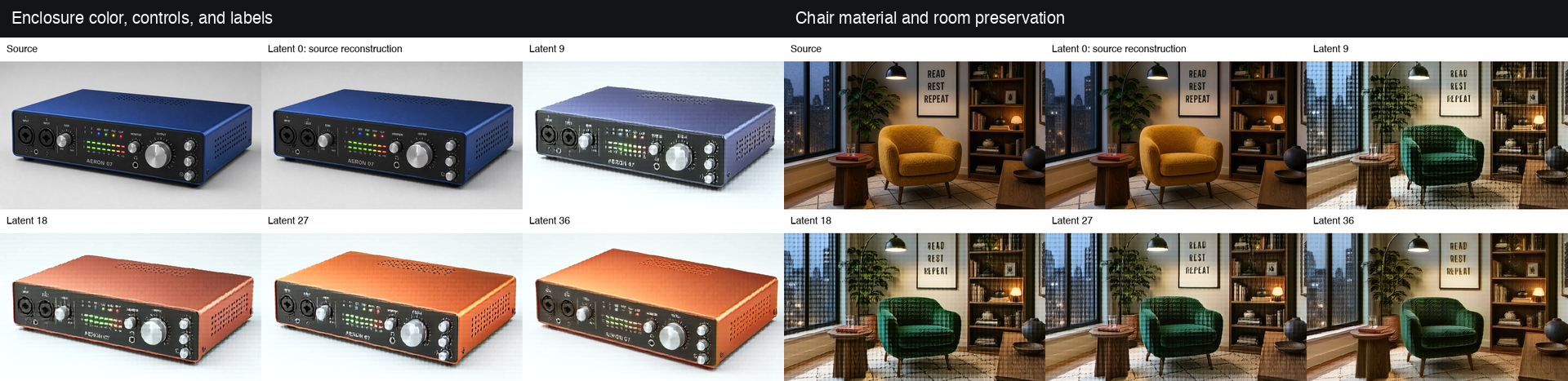
Two fixed edit transitions decoded by the 500K single-frame decoder
What it is and what it is not
The checkpoint is a decoder-only model: it has no encoder or transformer, and it is not a full MiniMax H3 replacement. It was fine-tuned from Mamad8/MiniMax-H3-Image-VAE with the frozen H3-compatible encoder, training the full decoder and post_quant_conv on 500,000 unique image-reconstruction examples without any text or captions.
The model card is explicit about the trade-offs:
- Best for structured content. Product contours, line art, diagrams, documents, and UI-like layouts decode most reliably.
- Sharper than the community decoder. In the fixed 8-prompt + 2-edit hard suite, the 500K decoder is consistently sharper and more coherent across natural detail, technical diagrams, product detail, architecture, repeated texture, and dense UI. Exact text remains a failure mode: package copy, diagram labels, signs, and UI headings are often incorrect.
- Not a video decoder. Do not treat it as a replacement for the MiniMax H3 video VAE. Still-image training supervised one temporal boundary condition, so later frames in a full-sequence decode can show grid or block artifacts, flicker, abrupt transitions, and texture drift.
Use cases
The intended scope is decoding a single H3 temporal latent slice into one image — useful for inspecting or editing an H3 latent as an image, running text-to-image experiments through a frozen generated latent, or first-frame-conditioned editing with H3's FL2VA workflow. The README documents these paths with fixed, preregistered examples: reconstruction, H3 T2I through a single latent slice, and FL2VA-based image editing, plus a "hard" suite of eight T2I prompts and two source-conditioned edits with no seed search or best-frame selection.
Because H3 still constructs and denoises its joint video/audio latent, this is substantially more expensive than a purpose-built image generator, and the authors recommend searching multiple temporal slices for edit tasks since composition, lighting, or material can drift during a transition.
Comments
Sign in with GitHub to join the discussion.