MiniMax H3 RAVEN LoRA: Real-Time Streaming Video in ComfyUI
RAVEN (Imperial College London) turns MiniMax H3 into a real-time streaming video generator via a 4-NFE LoRA adapter with official ComfyUI nodes for chunk-by-chunk output.
RAVEN (Real-time Autoregressive Video Extrapolation with Consistency-model GRPO), a research project from Imperial College London, releases a LoRA adapter that turns MiniMax H3 into a causal streaming generator: instead of denoising one bidirectional clip, the model generates video chunk by chunk, extrapolating each new chunk from previously generated content. The released preview adapter generates 192 frames at 1376×768 / 24 fps with just 4 sampling steps (NFE), and the project ships official ComfyUI nodes (ComfyUI-MiniMax-H3-RAVEN-Streaming) plus an end-to-end example workflow.
How it works
RAVEN keeps MiniMax-H3's architecture and adds a streaming head trained with consistency-model GRPO: each chunk is generated from the previous context with a small, fixed number of function evaluations. This makes generation progressive — content appears chunk by chunk rather than all at once — which is the key building block for real-time interaction. The 4-NFE preview adapter targets the video and audio grids jointly, so text-to-video-and-audio (T2VA) streams come out of the same causal pass.
The released weight is a LoRA adapter (r=128, lora_alpha=128) loaded on top of MiniMax-H3; it is an initial preview release, and the authors note that texture detail is still being improved.

RAVEN turns bidirectional denoising into causal, chunk-by-chunk streaming extrapolation (figure from the project page)
Demo
Streaming generation reel from the RAVEN project page (video from yanzuo.lu)
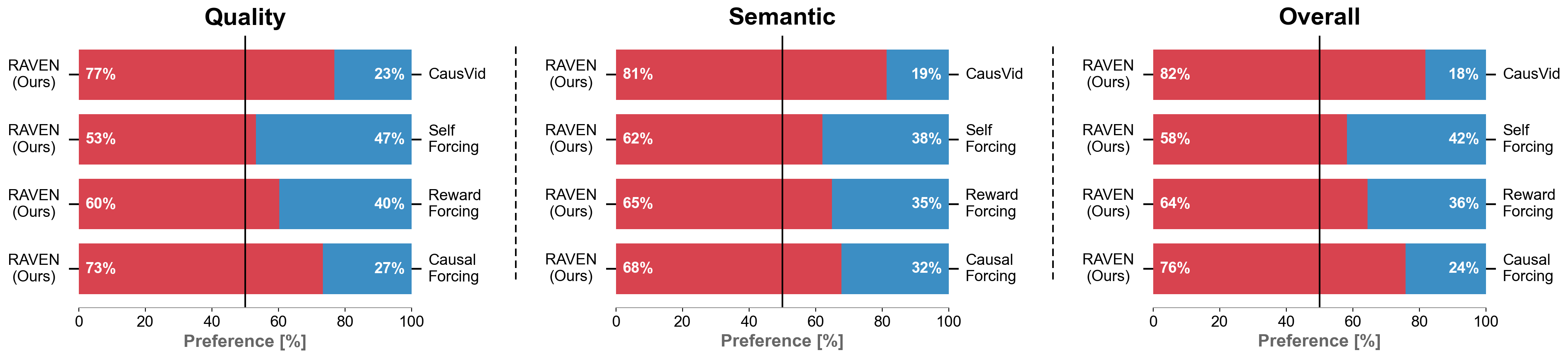
Human-preference comparison from the RAVEN paper
Model details
| Item | Value |
|---|---|
| Base model | MiniMaxAI/MiniMax-H3 |
| Adapter | LoRA, r=128, lora_alpha=128 |
| Sampling | 4 NFE (video and audio grids) |
| Frames | 192 |
| Resolution | 768 × 1376 |
| Frame rate | 24 fps |
| Causal chunking | sink=2, window=2 |
| Weight file | minimax_h3_raven_streaming_lora_4nfe_preview.safetensors (~5 GB) |
ComfyUI usage
The official nodes were released on August 20, 2026 and are published on the Comfy Registry as comfyui-minimax-h3-raven-streaming. Install by searching MiniMax H3 RAVEN Streaming in ComfyUI-Manager, or comfy node install comfyui-minimax-h3-raven-streaming, then restart ComfyUI.
- Install the custom nodes (ComfyUI-Manager or git clone into
custom_nodes/). - Download
minimax_h3_raven_streaming_lora_4nfe_preview.safetensorsintoComfyUI/models/loras/and the standard MiniMax H3 model files into their usual folders. - Load the bundled example workflow (Workflow → Browse Templates → Extensions, or drag the JSON below onto the canvas) and run.
The node pack implements the chunk-major streaming sampler, a streaming preview widget, and the mandatory RAVEN LoRA wiring on top of ComfyUI's built-in MiniMax H3 implementation. The authors validated 1376×768 / 192-frame generation inside a simulated 24 GiB VRAM envelope.
This is not native ComfyUI support: the streaming nodes depend on the third-party
ComfyUI-MiniMax-H3-RAVEN-Streamingcustom node pack.
Availability
- Weights: mvp-lab/MiniMax-H3-RAVEN-Streaming-LoRA (MiniMax H3 community license)
- Project page: yanzuo.lu/raven
- Paper: arXiv:2605.15190
- Code: mvp-ai-lab/RAVEN
- ComfyUI nodes: YanzuoLu/ComfyUI-MiniMax-H3-RAVEN-Streaming · Comfy Registry
Comments
Sign in with GitHub to join the discussion.