MiniMax H3 Hybrid Merge: FL2VA Quality Plus Ref2VA Reference Support
Download MiniMax H3 Hybrid: FL2VA quality plus Ref2VA references, including minimax_h3_hybrid_fl2va_ref2va_b25-49-int8.safetensors, with the ComfyUI Hybrid Loader node.
MiniMax H3 ships as two checkpoints with the same architecture: FL2VA, which produces the higher visual and audio quality, and Ref2VA, the only variant that supports reference-driven generation (image, video or audio reference conditioning) — but with noticeably worse raw output. A community project now merges the two into a single MiniMax H3 Hybrid checkpoint, and a companion custom node loads it directly in ComfyUI.
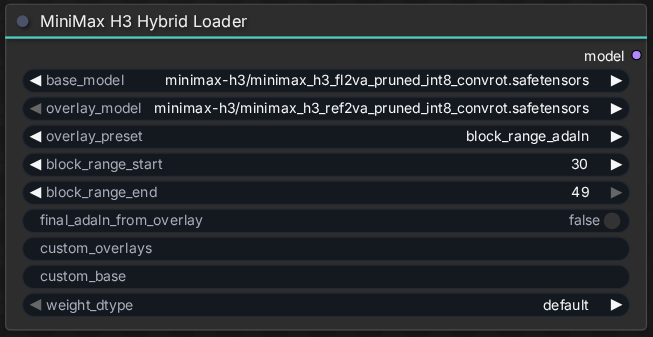
Recommended Hybrid Loader settings from the official project README
Why the merge exists
A tensor-by-tensor comparison of the two official checkpoints found that the overwhelming majority of weights — attention QKV/output projections, MLPs, RMSNorms, patch projections, rotary embeddings and the token refiner — are bit-identical or extremely close (cosine similarity ≥ 0.9997) between FL2VA and Ref2VA. The meaningful differences concentrate in the per-block adaln_proj weights: the AdaLN modulation projections that route text, audio, video and reference modality signals into the residual stream.
Because reference-conditioning processing is localized to those later-block AdaLN weights while general visual/audio fidelity lives in shared weights, a targeted merge looked promising instead of a lossy compromise: take FL2VA as the base for everything else, and pull the adaln_proj weights from Ref2VA for a configurable range of later transformer blocks.
Available variants
The merge was performed at the tensor level with no additional training. All variants use FL2VA as the base, differing only in how many of the 50 transformer blocks take their adaln_proj weights from Ref2VA:
| File | Blocks from Ref2VA | Tradeoff |
|---|---|---|
minimax_h3_hybrid_fl2va_ref2va_b30-49.safetensors | 30–49 (last 20) | Closest to FL2VA: highest output quality, reduced reference capability |
minimax_h3_hybrid_fl2va_ref2va_b25-49.safetensors | 25–49 (last 25) | Recommended default balance |
minimax_h3_hybrid_fl2va_ref2va_b20-49.safetensors | 20–49 (last 30) | Closer to Ref2VA: better reference adherence, slightly lower quality |
minimax_h3_hybrid_fl2va_ref2va_b15-49.safetensors | 15–49 (last 35) | Highest reference capability, some quality loss |
Each variant is a self-contained checkpoint with the same architecture and tensor layout as the source models (~21 GB), so it behaves like a normal diffusion model once loaded.
ComfyUI usage
The hybrid is not loadable with ComfyUI's stock Load Diffusion Model node, because no single stock loader knows how to compose two checkpoints. The companion MiniMax H3 Hybrid Loader (ComfyUI_MinimaxH3HybridLoader) fills that gap:
- Install the custom node into
ComfyUI/custom_nodes/and restart ComfyUI. It appears under model/loaders asMiniMax H3 Hybrid Loader. - Set base model to the FL2VA checkpoint and overlay model to the Ref2VA checkpoint.
- Pick a preset —
ref2va_adaln_over_fl2va(only per-block AdaLN from Ref2VA) orblock_range_adalnwithblock_range_start/block_range_endfor finer control (blocks are indexed 0–49). - The loader hands the merged state dict to ComfyUI's stock model loader, so the result is indistinguishable from a model loaded by
Load Diffusion Model— same patcher, same multigpu support, and int8.comfy_quantsiblings co-travel automatically.
The loader is memory-friendly: both safetensors files are opened mmap-backed and merged one tensor at a time, so peak RSS stays around one model's worth rather than two.
Availability
- Weights: smhfacct/Minimax-H3-fl2va-ref2va-hybrid-models on Hugging Face (four variants, ~21 GB each)
- ComfyUI node: scottmudge/ComfyUI_MinimaxH3HybridLoader on GitHub, with a full per-tensor analysis in
minimax_h3_analysis.md - Both source checkpoints remain unmodified; the merge inherits the original MiniMax H3 licensing terms
Comments
Sign in with GitHub to join the discussion.