MiniMax H3 Image VAE: Direct Single-Latent Image Decoding
Download minimax_h3_t1_image_vae_step1597.safetensors (5.2 GB): Mamad8's experimental MiniMax H3 VAE decodes a single T=1 latent directly into an image, no custom node required.
Mamad8 released an experimental image-specialized MiniMax H3 VAE on Hugging Face, shared on Reddit on August 9. The checkpoint decodes a single temporal latent (T=1) directly into one image, providing a usable direct-one-latent image path for the H3 24-channel latent format — distributed as a standard merged H3 VAE checkpoint, so no custom node or separate decoder head is required.
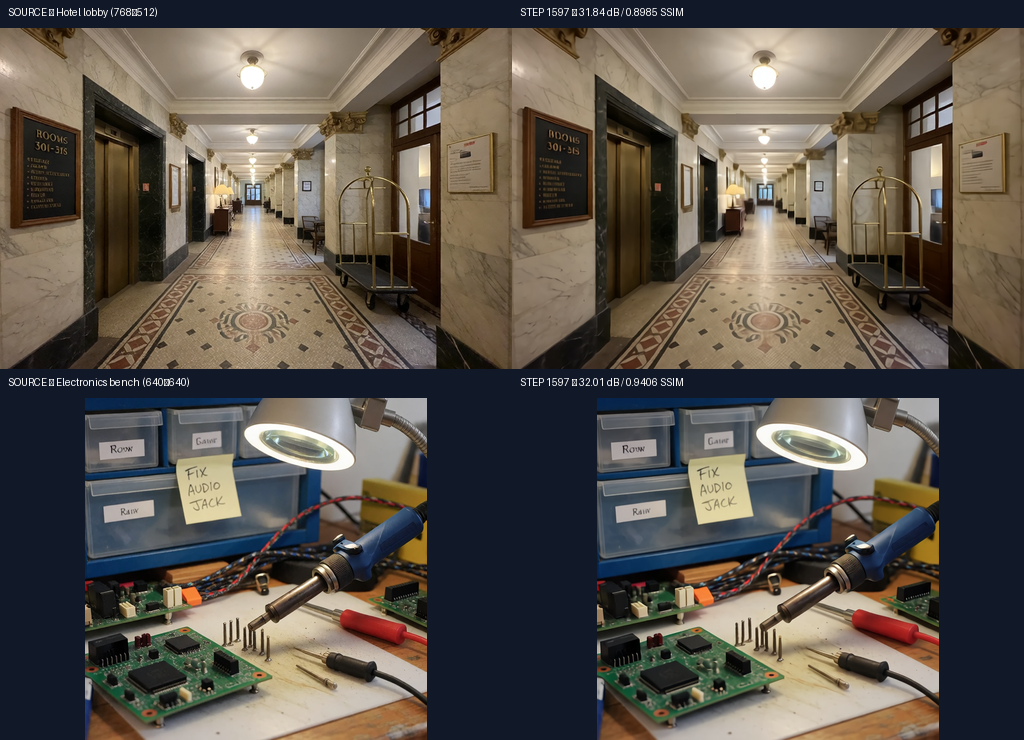
What it is and what it is not
The model card is explicit about the trade-offs:
- Images only. The image-specialized decoder materially regresses multi-frame video reconstruction and can introduce patch-grid ghosting and cross-frame mixing, so it must not replace the original H3 VAE in video workflows.
- Quality is limited. Outputs can stay soft and lose fine text, thin contours, hair, foliage and microtexture. The example image above shows the actual result rather than implying a quality guarantee — this is a utility path, not a fidelity claim.
Its purpose is to give H3 a workable single-image round trip, which matters for workflows that want to inspect or edit an H3 latent as an image.
How it was trained
The original H3 encoder was frozen while the full decoder and post_quant_conv were fine-tuned to reconstruct the real source image directly from one H3 temporal latent. Training used a progressive 256→384 px curriculum over 51,083 unique images (41,259 Booru Essence images and 9,824 pseudo-camera photographs) with a decoder-aware objective combining Charbonnier reconstruction, edge, SSIM and low-weight FDL/FDL-PIPS losses. The selected step-1597 decoder was merged back into the standard H3 VAE checkpoint, so it loads through normal H3 VAE tooling.
On a balanced unseen 512 px set (32 photos + 32 art images) the checkpoint measured 30.44 dB PSNR, 0.939 SSIM and 0.0168 MAE; deployment checks from ~1 to 3 megapixels reached 31.55–33.43 dB PSNR.
ComfyUI usage
- Download
minimax_h3_t1_image_vae_step1597.safetensors(~5.2 GB) intoComfyUI/models/vae/ - Load it with the standard Load VAE node and use the normal VAE encode/decode nodes
- The model expects MiniMax H3's 24-channel latent format and is intended for single-image (
T=1) round trips
Availability
The checkpoint is on Hugging Face. It pairs with Mamad8's earlier 2× latent upscaler for H3 latent-space workflows.
Comments
Sign in with GitHub to join the discussion.