MiniMax H3 Prompt Rewriter LoRA: Local T2VA Prompt Rewriting
Lightx2v's MiniMax-H3-Prompt-Rewriter-LoRA turns short prompts into structured H3 T2VA descriptions locally, with a ComfyUI node pack for the Qwen3.6-27B adapter.
The Lightx2v team released MiniMax-H3-Prompt-Rewriter-LoRA (Hugging Face), a LoRA adapter fine-tuned on Qwen3.6-27B that rewrites short prompts into the structured audio-video descriptions MiniMax H3 expects. It is a local alternative to MiniMax's hosted Context-IR prompt workflow: feed it a prompt plus aspect ratio and duration, and it outputs a shot-by-shot integrated_multimodal_description, overall_soundscape, and non_diegetic_music block ready for H3 generation.
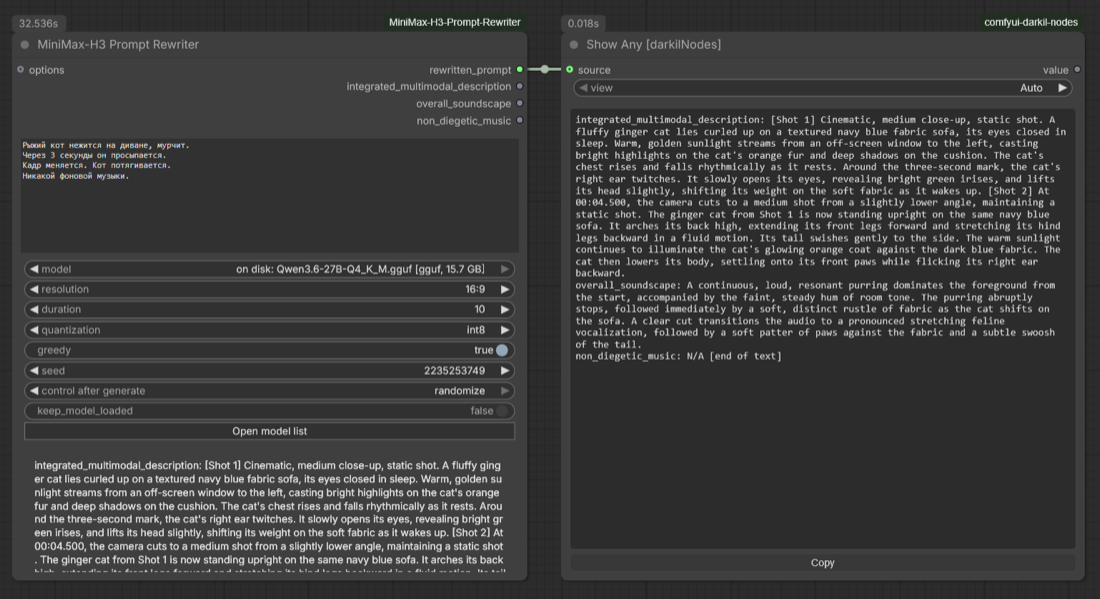
The prompt-rewriter node in ComfyUI: short prompt in, structured shot-by-shot description, soundscape and music out.
What it does
The adapter converts a short prompt plus the requested aspect ratio and duration into a structured H3 audio-video description:
Original prompt + aspect ratio + duration
                    │
                    ▼
          Qwen3.6-27B + this LoRA
                    │
                    ▼
integrated_multimodal_description: [Shot 1] ...
overall_soundscape: ...
non_diegetic_music: ...
The rewrite expands shot structure, timing, composition, camera motion, physical action, and continuity, and adds synchronized diegetic sound plus non-diegetic music while preserving the original intent. The current release supports text-only T2VA rewriting; first/last-frame-to-video (FL2VA) and reference-to-video (Ref2VA) rewriting are on the roadmap. Note that it is a learned approximation of the official H3-Context-IR service, not an exact replica.
ComfyUI nodes
Community member pytraveler packaged the LoRA as MiniMax-H3-Prompt-Rewriter-ComfyUI (GitHub), installable through ComfyUI-Manager or by cloning into ComfyUI/custom_nodes/. The pack ships three node groups:
- Rewriter node: runs Qwen3.6-27B with the LoRA, the reference implementation of the rewrite format
- Writer nodes: produce the same structured output from any instruction-following GGUF, covering T2VA, I2VA, FL2VA, L2VA and Ref2VA at roughly 2.6 GB download and ~5 GB VRAM
- Reference Caption / Multi Reference Caption nodes: turn an image, audio clip or video into the caption text the writer nodes need
Hardware requirements
The LoRA route loads a 27-billion-parameter base model: roughly 16 GB VRAM in nf4, ~28 GB in int8, or 13–19 GB via GGUF quantization with layer offloading. The community is already asking Lightx2v for a 4B/8B variant to lower the entry bar.
Availability
The LoRA is a text-side adapter: it rewrites prompts and does not include the MiniMax-H3 generator weights. Use it with LightX2V inference or the ComfyUI node pack above; the rewritten prompt feeds into MiniMax-H3 as usual. The 27B base model is downloaded from Hugging Face on first use.
Comparison
The videos below compare the same MiniMax-H3 checkpoint with identical inference settings; only the prompt-rewriting method differs: the raw prompt (no rewrite) versus Qwen3.6-27B with the H3-T2VA Context Rewriter LoRA.
| Original Prompt (No Rewrite) | H3-T2VA Context Rewriter LoRA |
|---|---|
| Epic space-opera teaser, raw prompt | Same prompt, rewritten by the LoRA |
Comments
Sign in with GitHub to join the discussion.