Nvidia PiD v1.5: Pixel Diffusion Decoder for FLUX.2 and Qwen-Image
Nvidia Research releases PiD v1.5 with improved decoding quality for FLUX, FLUX.2, and Qwen-Image — better color, fewer artifacts, and enhanced detail.
2kto4k_v1pt5 checkpoint variant for up-to-4K decoding.
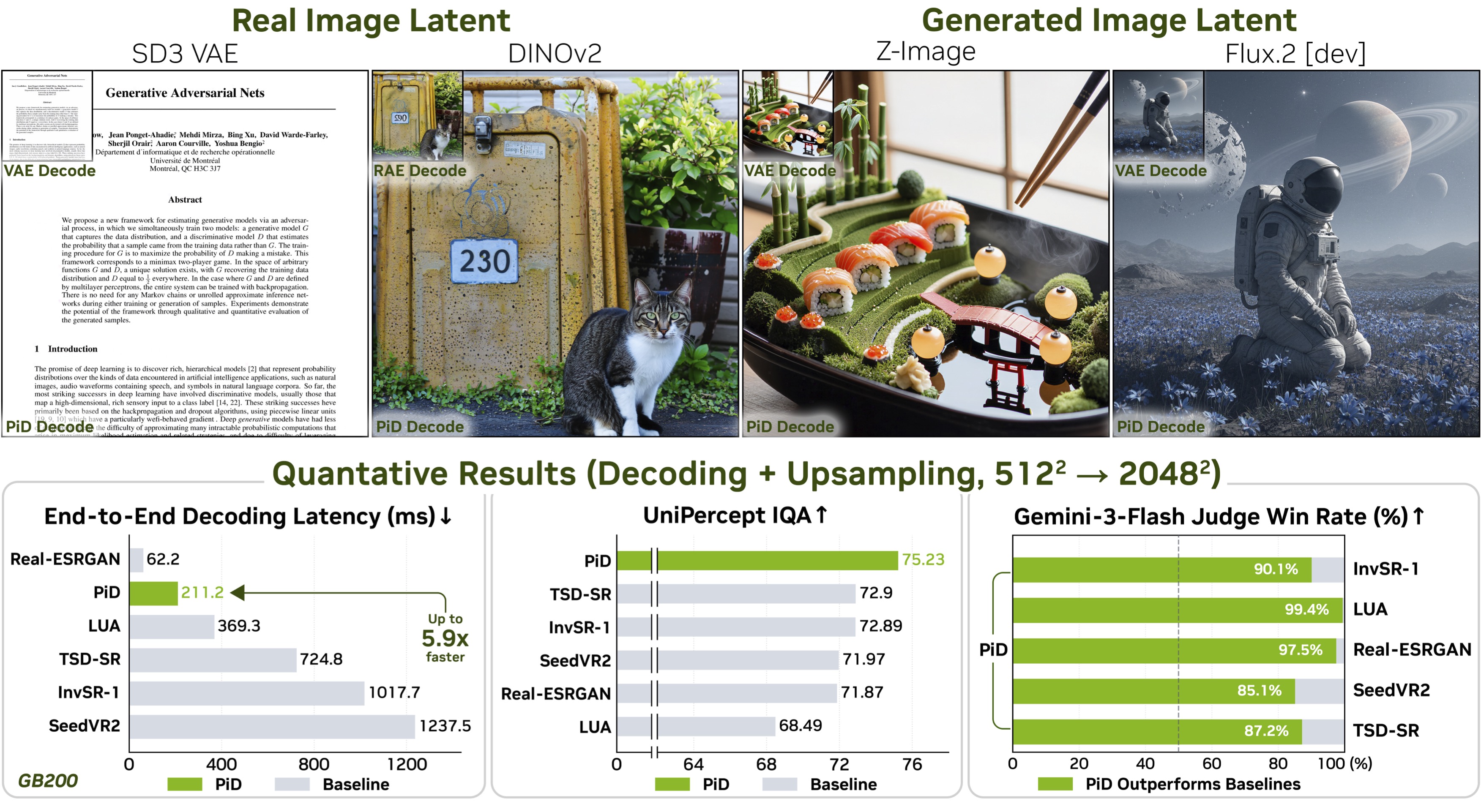
What is PiD?
PiD (Pixel Diffusion Decoder) reformulates the latent-to-pixel decoder as a conditional pixel-space diffusion model, unifying decoding and upsampling into a single generative module. Instead of the standard VAE decoder that simply inverts the encoder, PiD denoises directly in high-resolution pixel space and produces a super-resolved image in one pass.
The standard VAE decoder used in latent diffusion models (FLUX, SD3, SDXL) is reconstruction-oriented — optimized to invert the encoder rather than synthesize additional detail. PiD replaces this with a generative approach that can produce sharper, more detailed outputs at higher resolutions while maintaining consistency with the generated latents.
What's New in v1.5
PiD v1.5 brings targeted improvements across three major latent spaces:
- Improved decoding color fidelity — more accurate color reproduction from generated latents
- Removed grid artifacts in image corners — cleaner outputs, especially at high resolutions
- Improved anime and facial details — better handling of fine structural elements
The new 2kto4k_v1pt5 checkpoint is the recommended up-to-4K decoder for FLUX, FLUX.2, and Qwen-Image. Previous 2kto4k checkpoints for these models are deprecated and moved to checkpoints_deprecated/.
Available Checkpoints
All PiD checkpoints are 4-step distilled:
| Backbone | 2k Resolution | 2k-to-4k Resolution |
|---|---|---|
| FLUX | PiD_res2k_sr4x_flux_distill_4step | PiD_v1pt5_res2kto4k_sr4x_flux_distill_4step |
| FLUX.2 | PiD_res2k_sr4x_flux2_distill_4step | PiD_v1pt5_res2kto4k_sr4x_flux2_distill_4step |
| Qwen-Image | — | PiD_v1pt5_res2kto4k_sr4x_qwenimage_distill_4step |
The v1.5 2kto4k checkpoints also support Z-Image, Z-Image-Turbo, and FLUX.2-Klein (4B/9B) variants.
 |  |
|---|---|
| Standard VAE (512×512) | PiD v1.5 (2048×2048) |
Comparison: FLUX.2 latents decoded with the standard VAE decoder vs PiD v1.5 — note the improved color fidelity, reduced artifacts, and enhanced detail with PiD.
How It Works
PiD reformulates the latent decoder as a diffusion process in pixel space:
- The latent representation is first projected to a low-resolution pixel image via a lightweight encoder
- A conditional diffusion model denoises this low-resolution image, guided by the latent features
- The result is a high-resolution, detail-rich image in a single pass — combining decoding and upsampling
This approach means PiD can generate images at up to 4K resolution directly from standard latent representations, without requiring separate upscaling steps.
Ready-to-Use Workflows
Two official templates from the ComfyUI workflow library demonstrate PiD in action:
PiD Latent Upscale — apply PiD as a latent upscale/decoder replacement for FLUX, FLUX.2, and PixelDiT backbones.
PixelDiT Text-to-Image — full text-to-image pipeline using PixelDiT as the backbone and PiD for decoding.
Relevance to ComfyUI
PiD is available in ComfyUI through custom nodes (ComfyUI-PiD) and is already integrated into official template workflows. The PiD Latent Upscale workflow lets you use PiD as a drop-in VAE decoder replacement for FLUX, FLUX.2, and PixelDiT backbones, while the PixelDiT Text-to-Image workflow showcases end-to-end generation with PiD decoding.
The model is released under the NSCLv1 License (non-commercial research or evaluation only).



Comments
Sign in with GitHub to join the discussion.