NVIDIA Releases LocateAnything-3B - Open-Source Vision-Language Grounding Model with Parallel Box Decoding
NVIDIA open-sources LocateAnything-3B, a vision-language grounding model featuring Parallel Box Decoding (PBD) for fast and precise object localization, supporting object detection, GUI element grounding, OCR localization, and point-based grounding across diverse domains
On June 29, 2026, NVIDIA officially released LocateAnything-3B, an open-source vision-language grounding model that enables fast and high-quality visual localization from natural language instructions. The model introduces Parallel Box Decoding (PBD), a novel decoding paradigm that predicts complete bounding box coordinates in a single parallel step rather than autoregressive token-by-token decoding, achieving up to 2.5× higher throughput compared to prior approaches.
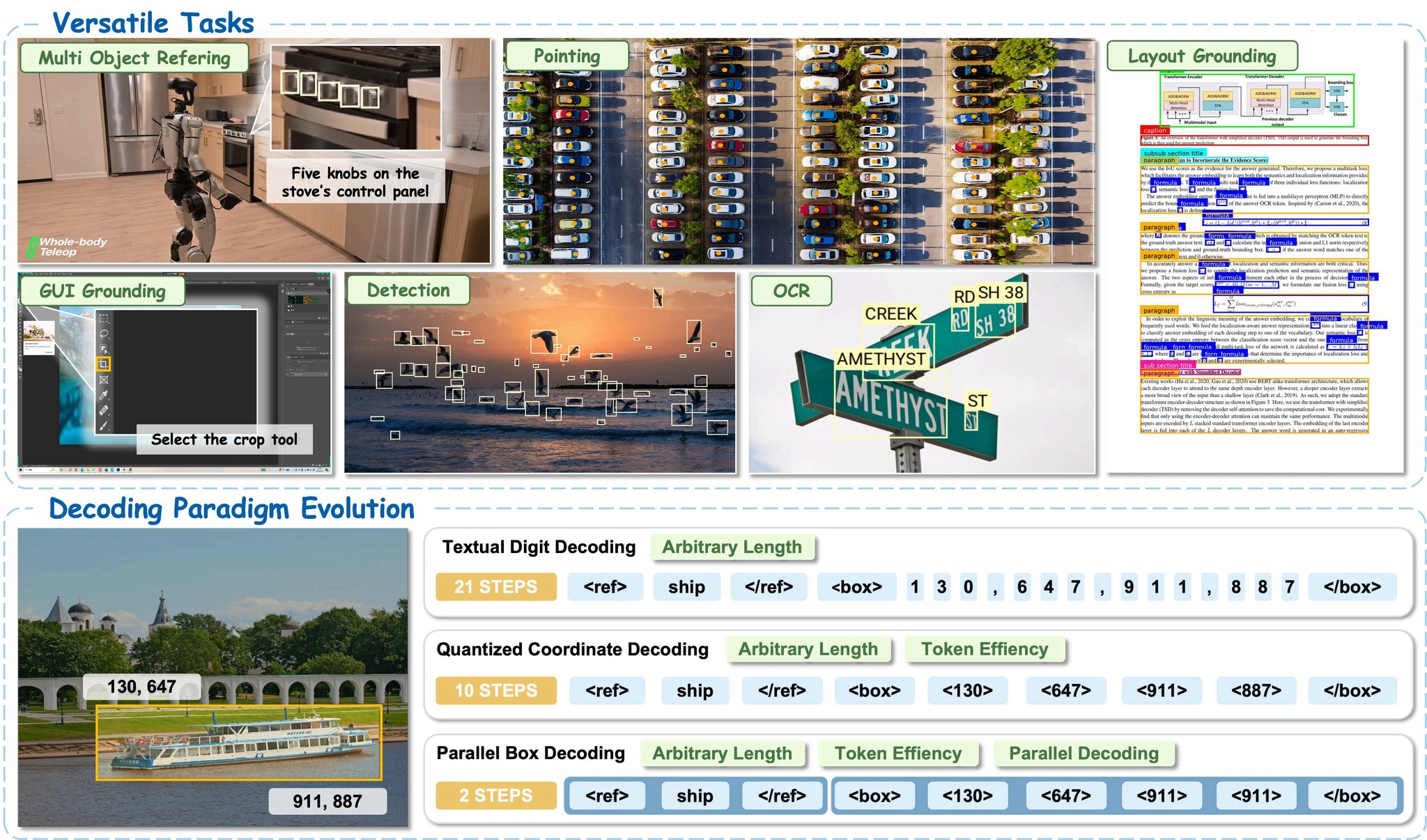 LocateAnything enables precise object localization across diverse domains including natural scenes, robotics, GUI interaction, and document understanding.
Model Overview
LocateAnything is a generalist vision-language grounding model developed as part of NVIDIA's Eagle VLM model family. It supports a wide range of localization tasks:
- Referring Expression Grounding: Locate objects described by natural language
- Open-Set Object Detection: Detect common and long-tail object categories
- GUI Element Grounding: Localize UI elements for agentic systems
- Document Layout Grounding: OCR and text localization
- Point-Based Localization: Fine-grained spatial reasoning via pointing
The model has been integrated into NVIDIA's Nemotron and Cosmos product lines, powering computer use and visual grounding features.
Core Innovation: Parallel Box Decoding (PBD)
Traditional visual grounding models generate bounding box coordinates autoregressively, token by token. LocateAnything introduces Parallel Box Decoding:
- Predicts complete bounding boxes (
x1, y1, x2, y2) and points in parallel structured units - Uses a block-wise multi-token prediction framework
- Achieves 2.5× higher throughput without sacrificing geometric consistency
- Supports three inference modes:
- Fast Mode: Parallel decoding for maximum speed
- Slow Mode: Autoregressive decoding for maximum accuracy
- Hybrid Mode: Default; parallel decoding with fallback to autoregressive for format irregularities
Technical Architecture
| Component | Details |
|---|---|
| Architecture | Transformer-based VLM |
| Vision Encoder | MoonViT (native resolution, up to 2.5K) |
| Language Model | Qwen2.5-3B-Instruct |
| Multimodal Projector | MLP projector |
| Total Parameters | 3B |
| Max Image Resolution | 2.5K (production), up to 4K with batch inference |
| Max Sequence Length | 25,600 tokens (training), 8,192 generation tokens (inference) |
| Output Format | Block-based: Semantic, Box, Negative, and End blocks |
Training Data
- 12M unique images, 138M+ queries, 785M bounding boxes
- Multi-domain: natural scenes, robotics, driving, GUI, documents
- Hybrid data sources: human-curated, open-source, model-assisted synthetic annotations
Performance
LocateAnything demonstrates strong performance across multiple grounding benchmarks including COCO/LVIS for open-set detection, ScreenSpot-Pro for GUI grounding, and various document layout understanding benchmarks.
Inference Efficiency
Using the la_flash attention backend with batch hybrid inference:
| Backend | Time (4K probe) | Peak Memory |
|---|---|---|
| SDPA (dense masks) | 8.26s | 35.12 GB |
| la_flash (FlashAttention) | 8.03s | 11.71 GB |
Open Source and Availability
LocateAnything-3B is released under the NVIDIA License for non-commercial research and development use:
- HuggingFace Model: nvidia/LocateAnything-3B
- GitHub Code: NVlabs/Eagle/Embodied
- Online Demo: HuggingFace Spaces
- Technical Report: arXiv:2605.27365
- Project Page: NVIDIA Research
Hardware Requirements
Optimized for NVIDIA GPUs (Ampere, Blackwell, Hopper, Lovelace) with BF16 precision and KV cache. Batch inference via la_flash backend reduces peak memory from 35GB to ~12GB on A100.
Related Links
- GitHub Repository: https://github.com/NVlabs/Eagle/tree/main/Embodied
- HuggingFace Model: https://huggingface.co/nvidia/LocateAnything-3B
- Online Demo: https://huggingface.co/spaces/nvidia/LocateAnything
- Technical Report: https://arxiv.org/abs/2605.27365